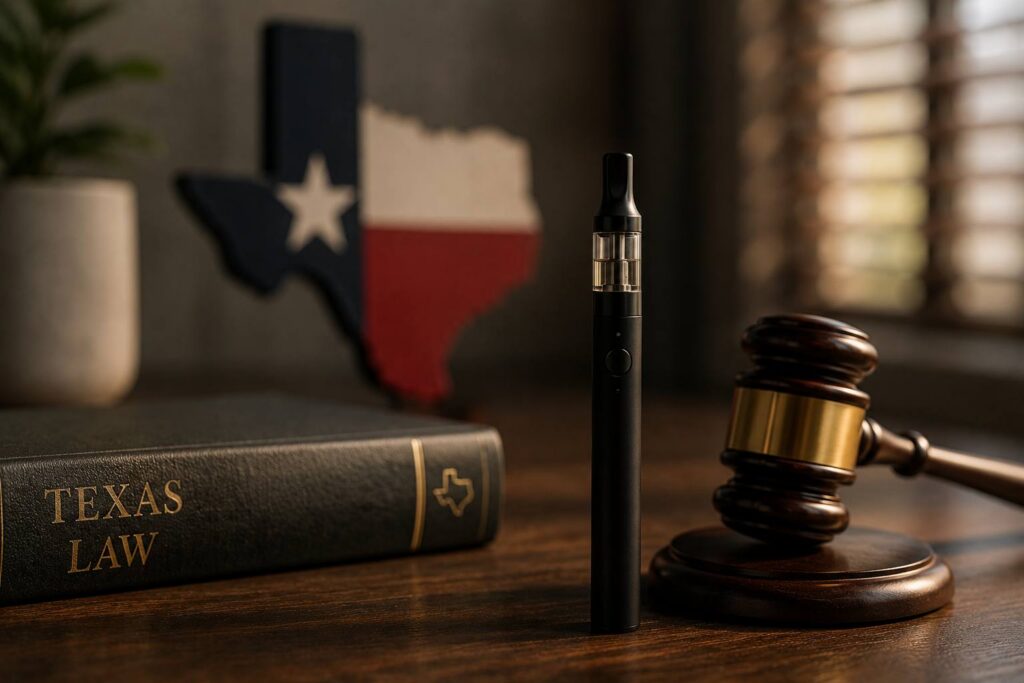
Vape pens are everywhere but in Texas, they can quickly turn into a serious criminal charge depending on what’s inside them.
Many people assume that because vape pens are so common, they’re automatically legal. That’s not always true.
At Austin Hagee Law Firm, we regularly help clients who are shocked to learn that what they thought was a minor charge can actually be a felony offense.
Here’s what you need to know.
The vape pen device itself is legal in Texas, but criminal charges depend on what substance is inside the cartridge or oil.
THC vape pens containing more than 0.3% THC can lead to felony drug possession charges under Texas Penalty Group 2 laws.
The State must prove through lab testing that the vape cartridge exceeds the legal THC limit before securing a conviction.
Receiving a Notice to Appear instead of being arrested does not mean the charge is minor — felony charges may still be filed later after lab analysis.
Strong defenses may involve challenging THC concentration testing, unlawful searches, improper seizures, or weaknesses in the prosecution’s scientific evidence.
Are Vape Pens Legal in Texas?
The device itself, a vape pen, is legal.
What matters is what’s inside the vape pen. The oil or substance that is being vaporized or heated must be legal too.
Nicotine vapes are legal. Hemp-derived CBD products with less than 0.3 percent THC are also federally legal, but on September 1, 2025, Texas made the sale of THC vapes with any concentration illegal. Depending on the percent concentration of the vape pen a person has in their possession, this may create a conflict of laws defense.
However, THC oil or cannabis concentrates are a completely different situation. Any vape cartridge containing more than 0.3 percent THC can lead to serious criminal charges. A vape pen with an illegal concentration above 0.3 percent THC will at least be charged as a state jail felony, and charges can be enhanced depending on the weight of the pen and oil it contains.
Why THC Vape Pens Can Be a Felony
This is where Texas law gets serious.
Unlike marijuana flower, which may be charged as a misdemeanor in small amounts, THC in vape pens is classified as a controlled substance under Texas law.
That means even a small amount can be a felony. Charges most often fall under Penalty Group 2, and you could face jail or prison time instead of just a ticket for possession of paraphernalia.
This is one of the most common situations where people feel blindsided by the law. They didn’t think they were doing anything that serious and suddenly they are faced with a felony.
The Burden Is on the State to Prove What the Substance Is
One of the most important things to understand is this: not every vape cartridge is illegal.
In Texas, hemp-derived CBD products can be legal if they contain less than 0.3 percent THC. But many vape cartridges look identical whether they are legal CBD or illegal THC concentrates.
Because of this, the burden is on the State to prove that the substance in the vape pen is actually an illegal concentrate. Remember though, these products can no longer be legally sold by a store in Texas.
If the State can legally prove that the product was not compliant with federal law, meaning it exceeds the 0.3 percent THC threshold, then you can still be charged and prosecuted with felony possession in Texas. However, they cannot simply presume that the substance is illegal without evidence showing the concentration.
That proof typically requires proper lab testing and reliable scientific evidence showing that the THC concentration exceeds the legal limit. If the State cannot meet that burden, it can create serious weaknesses in their case.
This is a critical area where an experienced criminal defense attorney can challenge the evidence and potentially create reasonable doubt. This challenge can take the form of a motion to suppress, a motion to quash, a motion to set aside, or a motion to dismiss.
What Happens If You Get Caught?
In many cases, instead of being taken to jail, you may receive something called a Notice to Appear. This is because Texas law-enforcement knows that they have to prove the concentration, and will wait until they get labs back before filing a case. However, this does not mean you will not get charged if the concentration was illegal, it just means a delay until the charges come.
What Is a Notice to Appear?
A Notice to Appear is a written order from law enforcement requiring you to show up in court at a later date after charges are filed.
Instead of being arrested and booked into jail, you are released at the scene, given a court date, and expected to appear as instructed.
It is important to understand that this is still a criminal charge. It is not less serious just because you were not taken to jail.
If you ignore a Notice to Appear, a warrant can be issued for your arrest. After a warrant is issued, you will be arrested and booked for the charge. On a state jail felony charge in Texas, a bond will need to be posted or waived by a judge before you can be released.
What Is a Pre-Trial Setting?
After your case begins, one of the first court dates you will have is called a pre-trial setting.
This is where your attorney and the prosecutor discuss your case, review evidence, and explore possible resolutions.
This stage is critical. It is often where cases are positioned for dismissal, reduced, or plea bargaining options arise. The decisions made here can shape the entire outcome of your case.
This is when having an experienced criminal lawyer matters the most. A lawyer that knows these cases, can push the weaknesses in your case to get an outcome that works for you. Good outcomes can include a dismissal, conditional dismissal, pre-trial diversion, and deferred adjudication. Poor outcomes can include long probation, jail sanctions, felony convictions,
Should You Hire a Criminal Defense Attorney?
This is one of the most important decisions you will make.
Yes, you may qualify for a court-appointed attorney. But there are important differences you need to understand between a hired and appointed attorney.
Court-appointed attorneys often have extremely high caseloads. That means less time per case and less opportunity for a tailored strategy. It also means less availability to work with you and update you on the progress of your case.
A private criminal defense attorney has more flexibility, more time, and more resources to focus on your case specifically. Also, a private attorney can specialize in a case area, like our firm does in THC-related cases.
This is not about saying one is good and one is bad. There are many hardworking court-appointed lawyers. The difference comes down to time, skill, and strategy. It also comes down to how much attention you want your case to receive, considering the risk of a felony conviction and prison time.
Why Hiring the Right Attorney Matters
With vape-related charges, especially those involving THC, you may be facing felony consequences.
That means your record, your career, and your future are all on the line.
A strong defense can be the difference between a conviction and a dismissal, a felony and a reduced charge, or a permanent record and a second chance.
Why Austin Hagee Law Firm Is Different
At Austin Hagee Law Firm, we take a different approach to criminal defense.
Our team is aggressive when it comes to protecting our clients, detail-oriented in how we build each case, and compassionate in how we treat the people who trust us during one of the most difficult times in their lives.
We care about our clients. That shows up in how we communicate. When you call our office, you will get an answer or a prompt call back. You will not be left wondering what is happening with your case.
Behind the scenes, we operate as a true team. We hold regular meetings to review and discuss every client’s case so that each matter benefits from multiple perspectives, strategies, and ideas. You are not relying on a single overworked attorney. You are getting the collective insight and attention of a group of legal professionals focused on your outcome.
That team approach allows us to be thorough. Every detail is examined. Every angle is considered. Nothing is overlooked.
Over time, our firm has built a reputation in the courtroom for being prepared, aggressive, and persistent. Prosecutors know that when our firm is involved, the case will be carefully scrutinized and every aspect of the evidence will be tested.
That reputation matters. It means your case is taken seriously from the beginning, and it reinforces our commitment to leaving no stone unturned in the pursuit of the best possible result for you.
The Austin Hagee Law Firm has worked to help more than 100 clients receive favorable outcomes in THC-related criminal charges. Our lawyers have more than 20 years of combined legal experience in criminal defense. The managing attorney of our firm, Austin M. Hagee, is a former prosecutor and has been recognized as a trusted and skilled criminal defense attorney in Texas as a SuperLawyer for years, a Top 100 Trial Lawyer, and recognitions by Forbes and Scene Magazine for his skill in criminal defense.
The Advantage of Our Team
When you hire our firm, you are not just hiring one attorney.
You are getting a full team that provides consistent updates, clear communication, and ongoing support.
We make sure you understand what is happening in your case and why.
Many firms leave clients wondering what is going on. We believe informed clients are empowered clients.
Do Not Wait to Get Help
If you have been charged with a vape-related offense or received a Notice to Appear, waiting can hurt your case.
The earlier you take action, the more options you may have and the better your outcome can be.
Call Austin Hagee Law Firm Today
If you are facing a criminal charge in Texas, you do not have to handle it alone.
Call Austin Hagee Law Firm today at 726-223-604 for a free consultation or reach out through our website.
Helping good people through hard times with the goal of restoring families.
Are THC vape pens illegal in Texas?
Yes. THC vape pens containing more than 0.3% THC are generally illegal in Texas and are often prosecuted as felony controlled substance cases under Texas drug laws.
Can a vape pen charge be a felony in Texas?
Absolutely. Unlike marijuana flower possession, THC concentrates and vape cartridges are typically charged as felony offenses, even in small amounts.
What is a Notice to Appear in a vape pen case?
A Notice to Appear is a court order requiring you to appear in court later instead of being arrested immediately. It is still a criminal case and ignoring it can lead to an arrest warrant.
Can the State prove a vape pen is illegal without lab testing?
Usually no. Prosecutors generally need laboratory testing and scientific evidence proving the THC concentration exceeds the legal limit.
Are CBD vape pens legal in Texas?
Some hemp-derived CBD vape products may still qualify as legal if they comply with THC concentration requirements. However, Texas law regarding THC vape products has changed significantly in recent years.
What happens at a pre-trial setting in Texas?
At a pre-trial setting, your attorney and the prosecutor review evidence, discuss defenses, negotiate possible resolutions, and evaluate whether the case can be reduced or dismissed.
Can vape pen charges be dismissed in Texas?
Yes. Depending on the facts, charges may be dismissed due to unlawful searches, weak lab testing, lack of proof regarding THC concentration, or favorable plea and diversion options.
Will a vape pen conviction stay on my record?
A felony conviction can remain on your criminal record permanently and may affect employment, housing, licensing, and educational opportunities.
Can first-time offenders avoid a conviction?
In some cases, yes. Deferred adjudication, pre-trial diversion, conditional dismissals, and other alternatives may be available depending on your background and case facts.
Should I hire a private criminal defense lawyer for a THC vape pen case?
These cases often involve complex scientific evidence and felony exposure. An experienced private criminal defense attorney may have more time and resources to aggressively challenge the prosecution’s case.

Austin M. Hagee is a trusted and proven San Antonio trial lawyer who tirelessly defends his clients’ constitutional rights. As a former prosecutor turned nationally recognized criminal defense attorney, Austin has the knowledge and expertise to get the best possible outcome for his clients.