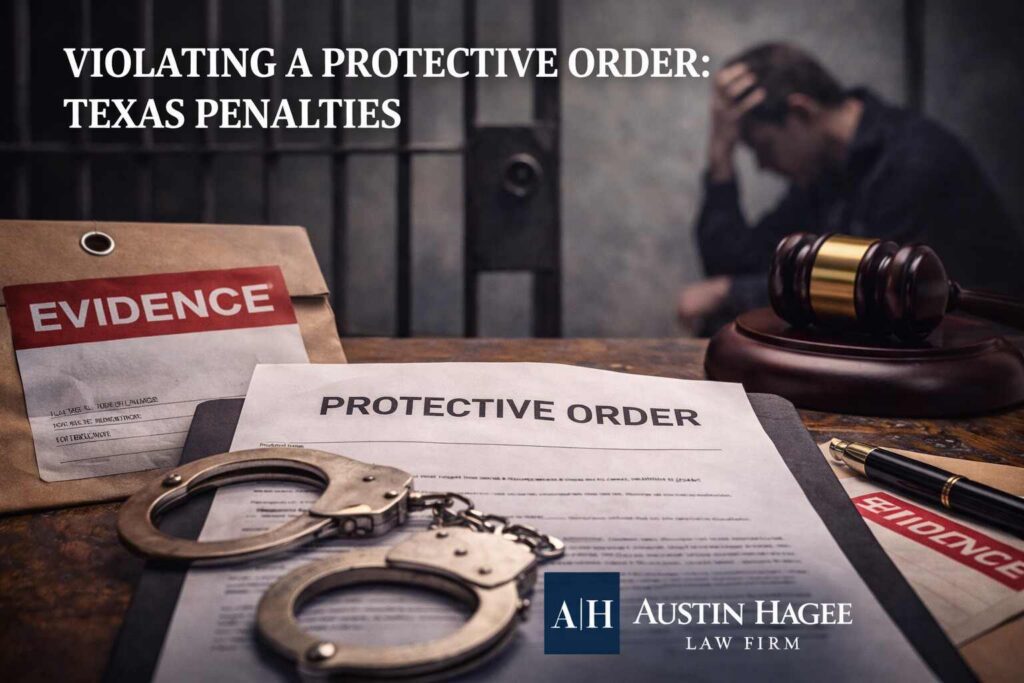
Facing an accusation of violating a protective order creates a storm of anxiety and uncertainty that can feel impossible to navigate alone. You likely feel like the system is already stacked against you, listening only to the other side while ignoring your efforts to move forward or co-parent peacefully. One misunderstood text message or an accidental encounter at a grocery store can suddenly jeopardize your freedom, reputation, and future. The penalties for violating a protective order in TX can include criminal charges, jail time, fines, and long-term consequences that affect your record and daily life.
You are going through a difficult chapter, and you deserve a legal team that sees your humanity rather than just a case number. At Austin Hagee Law Firm, we help good people, like you, get through hard times by aggressively defending your rights in court. Contact us today by calling us at 726-223-6041 to schedule your free consultation.
Violating a protective order in Texas is a criminal offense. Even a minor violation, such as sending a text message or approaching a restricted location, can lead to arrest and criminal charges.
Most violations are charged as Class A misdemeanors. A conviction may result in up to one year in jail and significant fines.
Some violations are felony offenses. Violating an order related to sexual assault, stalking, or repeated violations can elevate the charge to a felony.
Protective order violations include more than physical contact. Indirect communication, entering restricted areas, or possessing a firearm may all qualify as violations.
A conviction can have long-term consequences. Protective order violations can affect employment, housing, firearm rights, and future criminal cases.
Is a Protective Order Violation a Criminal Offense?
Understanding the severity of these charges is the first step in protecting your future. While many people mistakenly perceive these orders as simple civil matters, a violation is a criminal offense with immediate and lasting consequences. In Texas, the penalties for violating a protective order are divided based on the type of protective order. They can range from 180 days up to two years in a county or state jail facility, along with fines and other penalties. A violation is not a traffic ticket that eventually rolls off your record; a conviction leaves a permanent mark, which can potentially impact your employment, housing options, and your right to carry a firearm.
What Actions Constitute Breaking a Protective Order in Texas?
The violation of a protective order involves more than just physical contact; it encompasses a wide range of communications and actions, including:
- Communicating directly or indirectly. Sending text messages, emails, or even passing messages through a third party to the protected person can serve as the basis for an arrest.
- Going near prohibited locations. Entering the specific radius surrounding a protected person’s home, workplace, school, or childcare facility violates the order, even if the protected person is not present at the time.
- Possessing a firearm. Individuals subject to a protective order are typically prohibited from possessing a gun, and being caught with one constitutes a violation.
- Harming or threatening a pet. Interfering with the care, custody, or control of a pet or companion animal possessed by the protected person is a specific violation under state statute.
We will scrutinize the details of the allegation to determine if your actions actually meet the legal definition of a violation or if the accusation is a misunderstanding.
How Does a Judge Decide on Jail Time for Violating a Protective Order?
Not all protective orders have the same legal weight in Texas. The seriousness of your potential sentence often depends on the reason the court issued the order initially, as follows:
- The general rule (Class A misdemeanor). For most orders, such as those issued for general family violence, a violation falls under the misdemeanor classification. A conviction can result in up to one year in county jail and a fine of up to $4,000.
- The specific enhancement (state jail felony). The stakes increase dramatically if the court originally issued the protective order due to sexual assault, indecent assault, or stalking. In these cases, a violation, even a minor one, automatically becomes a state jail felony, which carries a sentence of 180 days to two years in a state jail facility and a fine of up to $10,000.
Because the difference between these charges turns on specific legal details regarding the original order, having an attorney who understands these nuances is essential for your defense.
Are There Specific Penalties for Repeated Violations?
Texas law treats repeat offenders with extreme severity, creating a separate offense for those accused of multiple violations within a short timeframe. If a person engages in conduct that constitutes a violation of a protective order two or more times within a 12-month period, the judge may charge them with repeated violation.
This statute combines separate misdemeanor acts into a single third-degree felony charge. As your attorney, we will aggressively defend against the charges of each alleged underlying incident.
Do Texas Restraining Order Violation Punishments Apply to Bond Conditions?
If a judge issues an emergency protective order or sets specific bond conditions prohibiting contact, violating the order or conditions carries the same criminal weight as violating a permanent order.
Therefore, any misstep means that you can face a new criminal charge for violating your bond conditions while your original case is still pending, effectively creating a “case within a case” scenario. If this happens, the judge can use the new charge to revoke your bond on the original charge, potentially keeping you in jail until trial. These laws apply equally to conditions of bond in cases involving family violence, sexual assault, or stalking.
Why Choose Austin Hagee Law Firm for Your Defense?
You are choosing a legal team that combines the strategic strength of a high-stakes trial lawyer with a genuine commitment to safeguarding the future of those facing overwhelming challenges. Austin Hagee Law Firm has a strong reputation as skilled advocates with extensive trial experience across a wide range of criminal cases. We have handled hundreds of criminal cases and achieved favorable outcomes in many of them, depending on the facts of each case. Our firm’s relentless dedication has earned us more than 200 five-star Google reviews from clients who found hope through our representation.
We understand that the justice system is not always fair, so we work tirelessly to ensure we treat every client with the respect they deserve. Recognized by Super Lawyers as a Rising Star and listed among the Top 100 Lawyers by The National Trial Lawyers, we bring award-winning experience to your case.
We also offer financing options, free consultations, and a military discount, as we believe top-tier defense should be accessible to everyone. When you hire us, you gain a 24/7 advocate ready to fight for your future.
Start Fighting for Your Future Today
Don’t let penalties for violating a protective order in TX define the rest of your life. Contact Austin Hagee Law Firm today by calling us at 726-223-6041 to schedule your free consultation. We are ready to defend your rights and guide you through the process so you can move forward with confidence.
Is violating a protective order a crime in Texas?
Yes. Violating a protective order in Texas is a criminal offense and can lead to arrest, jail time, fines, and a permanent criminal record.
What are the penalties for violating a protective order in Texas?
Penalties often include up to one year in jail and fines for a misdemeanor offense. Certain violations can lead to felony charges with longer prison sentences.
Can texting someone violate a protective order?
Yes. Direct or indirect communication, including text messages, emails, or social media contact, may be considered a violation.
Can accidental contact violate a protective order?
Possibly. Even unintentional contact may lead to an accusation if it occurs within restricted areas or involves communication prohibited by the order.
What happens if you violate a protective order more than once?
Repeated violations within a short period may elevate the offense to a felony, which can result in more severe penalties.
Does violating a protective order affect firearm rights?
Yes. Protective orders often prohibit firearm possession, and violating this restriction can result in additional criminal charges.
Can you go to jail for violating a restraining order in Texas?
Yes. A violation can lead to jail time depending on the nature of the offense and prior history.
Does violating bond conditions count as a protective order violation?
Yes. Violating no-contact bond conditions may result in additional criminal charges and bond revocation.
Can a protective order violation affect child custody?
Yes. Violations may be considered in family court and could impact custody or visitation decisions.
Do I need a lawyer if I am accused of violating a protective order?
Yes. Because these charges carry serious penalties, a criminal defense lawyer can review the allegations and help protect your rights.

Austin M. Hagee is a trusted and proven San Antonio trial lawyer who tirelessly defends his clients’ constitutional rights. As a former prosecutor turned nationally recognized criminal defense attorney, Austin has the knowledge and expertise to get the best possible outcome for his clients.