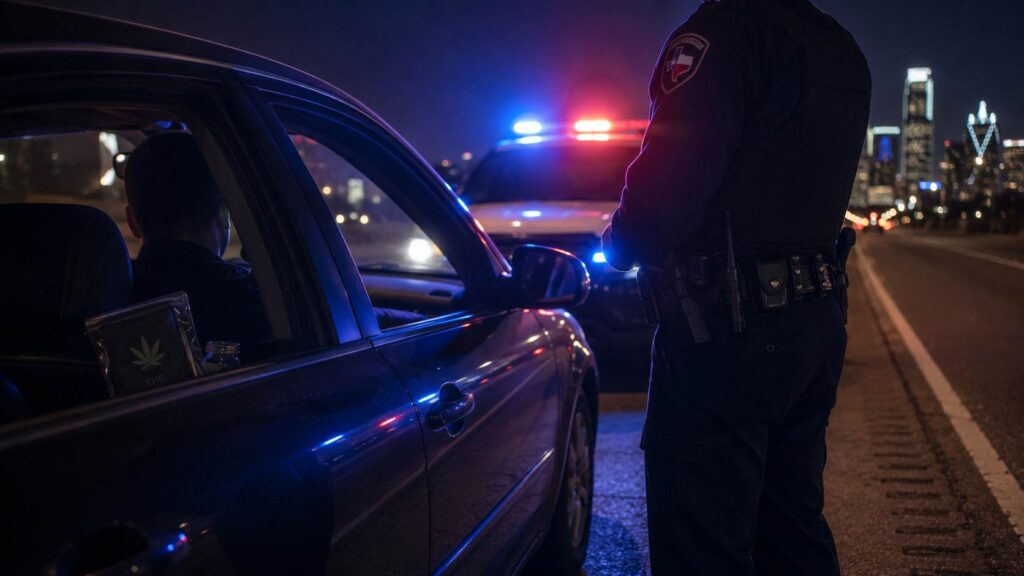
If you drive while intoxicated by THC, the State of Texas can charge you with driving while intoxicated (DWI). You can be convicted of a marijuana DWI in Texas if law enforcement provides evidence that indicates that marijuana impaired your ability to drive safely. Officers determine impairment based on your conduct at the time they stop you, rather than relying on a specific medical cutoff point like blood alcohol content (BAC) in alcohol-based DWI cases.
At Austin Hagee Law Firm, PLLC, we defend individuals facing DWI and other criminal charges across Texas. Our firm handles cases involving alcohol and drugs, including THC vape pen and marijuana-related DWIs. We understand how confusing THC charges can feel, especially when the law is less than clear.
Below, we explain how Texas law defines THC-related impairment, how the State attempts to prove you were driving while high, and what that means for your case.
Texas can charge you with a DWI for driving while impaired by marijuana or THC, even though the state does not use a legal THC limit like the 0.08 BAC standard for alcohol.
To secure a conviction, prosecutors must prove that THC impaired your normal mental or physical faculties while you were operating a vehicle in a public place.
Marijuana DWI cases often rely on officer observations, field sobriety tests, Drug Recognition Expert evaluations, and chemical testing rather than a specific THC threshold.
A positive THC test alone does not automatically prove impairment because THC can remain in the body long after its effects have worn off.
Potential defenses include challenging the legality of the traffic stop, disputing field sobriety or laboratory evidence, and arguing that the State cannot prove actual impairment while driving.
When Can You Get a DWI for Weed in Texas?
If an officer arrests you after concluding you drove while impaired on THC, they typically charge you with driving while intoxicated. In general, you get a DWI, not a DUI, for weed. DUI charges apply only to individuals under age 21 who have any detectable amount of alcohol in their system, regardless of impairment.
To find you guilty of a marijuana DWI in Texas, the State must prove that:
- Marijuana impaired your normal ability to think or control your body,
- While you operated a vehicle,
- In a public place.
A first offense is usually a Class B misdemeanor and may carry jail time, fines, and license suspension.
Impairment
To convict you of THC-based DWI, the State has to prove that marijuana affected your mental or physical abilities while you drove. Signs of impairment may include that you:
- Reacted slowly to traffic conditions,
- Struggled to stay focused on the road,
- Had difficulty with coordination or balance, or
- Made unsafe or delayed driving decisions.
A marijuana DWI often focuses more on your conduct than an alcohol DWI. The State may, however, request and rely on a urine or blood test that measures relative THC levels in your body. These results may support the State’s case, but do not, by themselves, establish impairment at the time of driving.
While Operating a Vehicle
The State must also connect the alleged impairment to the actual operation of a vehicle. “Operating” is broadly interpreted under Texas law and can include more than just driving, depending on the facts. Vehicles generally include highway-capable motorized devices.
Public Places
A person commits DWI by driving in a public place. Public places typically include roads, highways, parking lots, and other areas open to the public.
What Evidence Do Police Use to Prove Driving High in Texas?
To prove a marijuana DWI in Texas, the State must show that marijuana affected your normal ability to think or move while you were driving. Prosecutors typically rely on a combination of evidence, such as:
- The officer’s description of your driving and behavior,
- Video from dash cameras or body cameras,
- Your performance on field sobriety tests,
- An intoxication expert’s opinion, and
- Chemical test results showing THC presence.
Because Texas does not use a THC limit, the case often depends on whether this evidence convinces a jury that you experienced impairment at that specific time.
Driving Behavior
An officer often testifies to describe what they observe on the road, providing the State’s core evidence. To stop your vehicle, an officer must have reasonable suspicion—they must have observed specific facts that suggest a traffic violation or possible criminal activity, justifying the initiation of a traffic stop.
Examples include:
- Drifting between lanes,
- Driving significantly slower or faster than traffic, and
- Delayed responses to traffic signals.
These observations can provide a legal basis for a traffic stop.
Physical and Behavioral Observations
After the stop, the officer looks for signs they associate with marijuana use, such as:
- Red or bloodshot eyes,
- Slow speech or delayed responses,
- Confusion when answering simple questions, and
- The odor of marijuana.
These signs depend on the officer’s interpretation. Many of these observations can also result from non-criminal causes, such as fatigue, allergies, or stress.
Field Sobriety Tests
Officers may ask you to perform roadside balance and coordination tests, often called field sobriety tests, such as:
- Horizontal gaze nystagmus (eye test),
- Walk-and-turn test,
- One-leg stand test,
Field sobriety tests were designed primarily for alcohol impairment, but officers also use them in suspected drug or THC-based impairment cases.
Chemical Tests and Evaluations
Police may also request a blood or urine test to detect THC. In some cases, a specially trained officer, a Drug Recognition Expert (DRE), may conduct a more detailed evaluation. A DRE may:
- Check your blood pressure, pulse, and other vital signs;
- Examine eye reactions and muscle tone; and
- Ask questions about recent substance use.
The DRE then gives an opinion about whether a drug caused impairment. Courts treat this opinion as one piece of evidence, and a defense attorney can challenge it.
Defenses to Marijuana DWI Charges
A marijuana DWI case often turns on whether the State can prove actual impairment. Your lawyer can help you decide what defense to pursue and pursue it on your behalf.
No Actual Impairment
Prosecutors must show that you were intoxicated and that intoxication impaired your normal abilities, making it unsafe for you to drive. If the State cannot prove impairment at the time you were operating a vehicle, it cannot sustain a DWI conviction.
Lack of a Valid Traffic Stop
Officers must have a legally valid reason to initiate a traffic stop—reasonable suspicion. If the officer lacked a valid basis to stop your vehicle, a court may exclude evidence gathered after the stop as unconstitutional.
Problems with Testing Evidence
Field sobriety tests have limitations and can produce misleading results. Your defense may highlight alternative explanations for failures, such as:
- Medical conditions that affect balance or coordination,
- Environmental conditions like poor lighting or uneven pavement, and
- Instructions that confused or misled the driver.
We also evaluate whether the officer followed the necessary procedural steps that create reliable evidence during testing and evaluations.
Chemical test evidence requires proper handling and accurate processes. Your defense may challenge whether:
- Officers and lab personnel handled the sample correctly,
- The lab conducted the test accurately, or
- The results actually connect to impairment at the time of driving.
Your lawyer may also challenge whether blood and urine testing can reliably establish impairment.
Talk to Austin Hagee Law Firm About Your Case
If you are facing a marijuana related DWI charge in Texas, understanding how the State builds its case is critical. At Austin Hagee Law Firm, PLLC, we represent clients throughout Texas in DWI, DUI, and drug-related cases, and we understand how to analyze these cases from both sides to help you make informed decisions about what comes next.
Contact Austin Hagee Law Firm today to discuss your case. Call us on 726-223-6041.
Can you get a DWI for marijuana in Texas?
What is the THC limit for driving in Texas?
Can you be charged with DWI if THC shows up on a blood test?
How do police determine if you are driving high in Texas?
Can a first marijuana DWI be a misdemeanor?
Can field sobriety tests prove marijuana impairment?
What defenses are available in a marijuana DWI case?
Can prescription or medical marijuana be a defense to a Texas DWI?
Can a marijuana DWI affect your driver’s license?
Should I hire a lawyer for a THC-related DWI charge?
Legal References Used to Inform This Page
To ensure the accuracy and clarity of this page, we referenced official legal and other resources during the content development process:
- Definition of motor vehicle, Texas Penal Code § 32.34.
- Driving while intoxicated, Texas Penal Code § 49.04.
- Texas Impaired Driving Task Force, DUI laws and consequences.
- Texas State Law Library, Cannabis and the Law.

Austin M. Hagee is a trusted and proven San Antonio trial lawyer who tirelessly defends his clients’ constitutional rights. As a former prosecutor turned nationally recognized criminal defense attorney, Austin has the knowledge and expertise to get the best possible outcome for his clients.