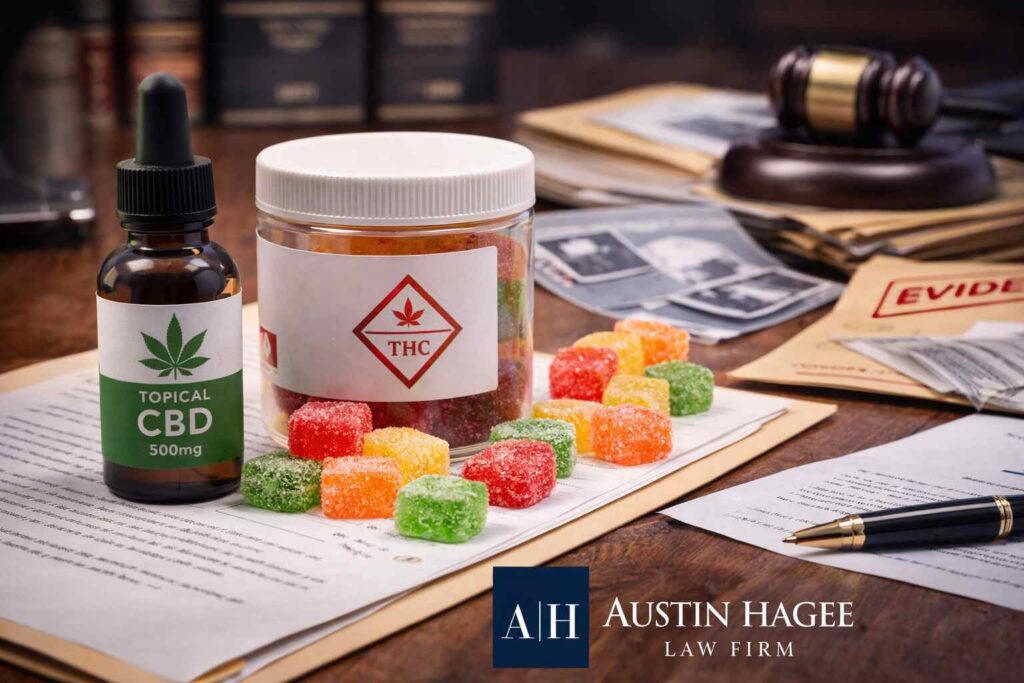
Gummies, chocolates, and baked goods labeled “hemp-derived” or “legal THC” are now common in Texas stores. Many assume these are legal until a traffic stop, workplace issue, or police encounter raises serious questions: Are edibles legal in Texas?
The short answer is that legality depends on what is inside the edible, its classification under Texas law based on chemical composition, and laboratory testing. The longer answer matters far more, especially if your freedom or record is on the line.
If you’re facing a situation involving THC edibles, speaking with a qualified attorney can help you understand your rights. Contact us today by calling us at 726-223-6041 to schedule your free consultation.
Key Takeaways:
- Edibles are not automatically legal in Texas just because they are sold in stores. Whether a product is lawful often depends on its THC content, whether it qualifies as hemp under Texas law, and what later laboratory testing shows.
- Texas treats many THC edibles more seriously than people expect. A small package of gummies can lead to criminal exposure because law enforcement and prosecutors may focus on product classification and total aggregate weight, not just the number of pieces.
- CBD edibles are only as legal as their chemistry. Labels that say “CBD,” “hemp-derived,” or “legal THC” do not control the outcome if testing suggests the product exceeds legal hemp limits.
- Field encounters often move faster than the science. Officers usually cannot confirm legality on the spot, which means arrests and charges may happen first while the case later turns on lab testing, weight calculations, and statutory definitions.
- Early legal review can make a major difference. Cases involving THC or CBD edibles often rise or fall on technical details, including search issues, testing procedures, and whether the product was properly classified under Texas law.
Are Edibles Legal in Texas?
Edibles are not broadly legal in Texas. Many edibles containing delta-9 tetrahydrocannabinol (THC), the primary psychoactive component in cannabis, qualify as illegal controlled substances under the law.
Texas does not recognize a general “marijuana edible” exception. Edibles fall into two categories:
- Hemp-derived products that meet legal limits; and
- Illegal marijuana products.
Edibles, whether gummies, brownies, or candies, can blur these lines, causing arrests even when the product packaging claims legality. Minor chemical differences can result in different criminal outcomes.
Is CBD Legal in Texas?
Cannabidiol (CBD), a non-psychoactive compound in cannabis, is legal in Texas only if it meets strict statutory requirements.
Texas permits hemp-derived CBD products, including certain edibles, only if they contain no more than 0.3% delta-9 THC by dry weight and originate from lawful hemp. Enforcement can be complex, as lab testing, mislabeling, and trace amounts of THC can transform a “CBD gummy” into alleged evidence of a crime. The legality of hemp products depends on their chemical composition, not their marketing claims.
Even when CBD is lawful, possession can raise concerns if police believe the edible contains illegal THC or if testing is inconclusive at the scene.
What Do THC Edible Laws in Texas Actually Say?
THC edibles are illegal in Texas when they contain marijuana-based THC or exceed legal hemp limits.
Under Texas’s Controlled Substances Act, THC is classified as a controlled substance unless it qualifies as hemp-derived under strict statutory definitions. Edibles containing delta-9 THC above the legal threshold receive the same treatment under the law as marijuana. There is no exception for gummies, baked goods, or other consumables.
This situation is where many people get caught off guard. An edible that is legal in another state or sold openly in Texas may still lead to criminal charges if testing shows prohibited THC levels.
Are Edibles Legal in Texas in 2026?
As of now, edibles remain heavily restricted, and proposed legislation may make enforcement even stricter.
The trend points toward more regulation ahead, not less. Texas legislators are considering potential bans on specific hemp-derived THC products, increasing fees for retailers, and tightening oversight of all consumable hemp items. Recent reports indicate increasing support for either restricting or removing products that currently exist in a legal gray area.
That uncertainty matters because charges depend on the law in effect at the time of the alleged offense, not on retailer representations or what future legislation might allow.
Are THC Edibles a Misdemeanor or Felony in Texas?
Possessing marijuana edibles can be misdemeanors or felonies depending on the weight and classification.
Texas law does not charge people based on the number of gummies. Instead, prosecutors often base charges on the total weight of the edible, including both the food product and the drug, which can increase criminal penalties.
Because THC concentrates and consumables qualify as controlled substances, penalties can escalate quickly. Texas law sets out these classifications in its penalty sections for controlled substances. Actual charging decisions depend on laboratory results, prosecutorial discretion, and the substance’s classification under Texas law.
In practical terms, this means a small bag of gummies can carry consequences far more serious than most people expect.
Why Edibles Lead to Arrests Even When Stores Sell Them
Many people assume that because they can buy edibles in stores, those products are legal. However, Texas law does not work that way. Edibles frequently lead to arrests because:
- Field testing is limited. Officers cannot reliably distinguish legal hemp edibles from illegal THC products during a stop, which often leads to an arrest pending lab testing.
- Labeling is not proof. Product labels do not establish THC content as a matter of law, even when they appear professional or compliant.
- Weight calculations are unforgiving. Texas law may count the entire edible toward charge severity, not just the THC concentration.
- Laws are changing fast. Shifting regulations create confusion about enforcement that almost always falls on the person in possession.
That gap between consumer expectations and criminal enforcement is where defense strategy becomes critical.
How a Texas Defense Lawyer Can Help with Edible Charges
Cases involving edibles are technical, often focus on lab testing, and depend on highly detailed facts.
A defense attorney can challenge lab testing procedures, analyze whether the product meets the criteria of a controlled substance under Texas law, and contest improper weight assessments or unlawful searches. These cases often depend on specific details that are not apparent at the moment of arrest but become crucial in court.
Make Decisions Based on Law, Not Assumptions
THC edible cases in Texas often turn on details most people never knew mattered until they were facing charges. Lab testing standards, statutory definitions, and the process for calculating weight can quietly determine whether a case holds together or falls apart.
At Austin Hagee Law Firm, we truly understand your situation because we have examined cases from both perspectives. This experience helps us identify potential issues early, challenge assumptions in the charges, and uphold accountability when necessary. Our firm focuses on early intervention, strategic motion practice, and maintaining open, transparent communication so you remain informed throughout your case.
If you are dealing with questions, an investigation, or a pending charge involving THC or CBD edibles, early review under Texas law can preserve options and reduce uncertainty about what comes next. Contact Austin Hagee Law Firm by calling us at 726-223-6041 to schedule a consultation and get a clear, fact-based assessment of your situation before assumptions turn into consequences.
FAQs
Are CBD Gummies Sold in Texas Always Legal?
No. CBD gummies are legal only if they meet Texas hemp standards and contain no more than 0.3% delta-9 hemp-derived THC. Products that exceed that limit may lead to criminal charges.
Can I Be Arrested Even If I Bought Edibles Legally in Texas?
Yes. Retail availability does not guarantee legality under Texas criminal law, and officers may arrest first and rely on lab testing later.
Do THC Edibles Count as Marijuana Under Texas Law?
It depends. Texas law distinguishes between hemp-derived THC and marijuana-derived THC.
Hemp-derived delta-9 THC edibles are legal only if they do not exceed 0.3% delta-9 THC by dry weight. If the edible exceeds that limit, it loses hemp status and is typically charged as possession of a controlled substance under Texas law. Edibles made with marijuana-derived THC are illegal regardless of percentages.
Does the Weight of the Edible Matter?
Yes. Texas may consider the total weight of the edible, not just the THC content, when determining charge severity.
Can Delta-8 or Delta-10 Edibles Still Cause Criminal Problems in Texas?
Yes. Even when a product is marketed as hemp-derived delta-8 or delta-10, legality can still become a problem if laboratory testing, labeling issues, or product composition place it outside Texas hemp limits. Retail packaging does not control how law enforcement or prosecutors classify the edible.
Can I Be Charged for THC Edibles I Brought Into Texas from Another State?
Yes. A product that was lawfully purchased in another state can still create criminal exposure once it is brought into Texas. The key question is how the edible is classified under Texas law at the time of the alleged offense, not whether it was sold legally somewhere else.
Do Police Have to Prove Exactly What Is Inside an Edible Before a Case Can Hold Up?
In most cases, the state will ultimately need reliable evidence about the edible’s composition and classification. That is why testing procedures, chain of custody, product weight, and the distinction between lawful hemp and illegal THC products can become central issues in defending an edible-related case.
Legal References Used to Inform This Page
To ensure the accuracy and clarity of this page, we referenced official legal and other resources during the content development process:
- Controlled Substances Act, Texas Health and Safety Code, Chapter 481, link.
- Houston Public Media, Texas Set to Ban Smokeable Cannabis as Soon as January 2026, link.
- Texas Health and Safety Code § 481.121, link.
- Texas State Law Library, Cannabis: General Information, link.
- Texas State Law Library, Consumable Hemp Products, link.
- Texas Department of State Health Services, Annual Republication of Schedules of Controlled Substances (2025), link.

Austin M. Hagee is a trusted and proven San Antonio trial lawyer who tirelessly defends his clients’ constitutional rights. As a former prosecutor turned nationally recognized criminal defense attorney, Austin has the knowledge and expertise to get the best possible outcome for his clients.