



Key Takeaways
- Unlawful Carrying of a Weapon (UCW) in Texas is defined by Texas Penal Code §46.02 and covers handguns, illegal knives, and clubs carried unlawfully.
- Most UCW charges are Class A misdemeanors — up to one year in county jail and a fine of up to $4,000.
- UCW becomes a third-degree felony (2–10 years in prison, up to $10,000 fine) when the weapon is carried into a §46.03 prohibited place like a bar, school, polling place, or government building, or when the accused is a convicted felon.
- “Unlawful carry” and “unlawful possession of a firearm” are two different offenses. Unlawful possession (§46.04) is the felon-in-possession statute and is always a felony.
- Typical bond for a Class A UCW in Texas is $1,500–$3,000, set at magistration. Felony UCW bonds are usually $5,000–$20,000 depending on criminal history and the county.

Unlawful carry of a weapon (UCW) in Texas refers to the illegal possession of handguns, clubs, illegal knives, or other harmful weapons. UCW is a Class A misdemeanor, punishable by up to 1 year in jail and a $4,000 fine. It involves knowingly or recklessly carrying a handgun or weapon where it’s banned. If done in restricted areas or by a felon, it becomes a third-degree felony.
Texans can receive an unlawful carrying of a weapon charge, even if they have a license to carry, for possessing restricted weapons in the wrong location or while committing another crime that is a Class B misdemeanor or higher.
Texas boasts a strong gun culture, but responsible gun ownership goes hand-in-hand with understanding the law, and Texas prosecutors do not treat UCW cases lightly. If you are uncertain about the laws regarding carrying a firearm in Texas, you are not alone.
Today, the San Antonio criminal defense attorneys of Austin Hagee Law Firm provide an overview of Texas’s unlawful carrying of a weapon or UCW law, including potential consequences, bond amounts, the difference between UCW and unlawful possession of a firearm, and defenses against an illegal carrying of a weapon charge.
If you would like to share your story with a defense lawyer or if you have questions after reading this article, please contact us today by calling us at (210) 500-3700.
What Is the Unlawful Carrying of a Weapon?
Quick answer: Unlawful Carrying of a Weapon (UCW) in Texas is the offense of intentionally, knowingly, or recklessly carrying a handgun, illegal knife, or club in a manner or location prohibited by Texas Penal Code §46.02. It is usually a Class A misdemeanor, but becomes a third-degree felony when the weapon is carried into a §46.03 prohibited place or by a person with a prior felony.
UCW (Unlawful Carrying of a Weapon) in Texas refers to the illegal possession of a handgun, club, or other dangerous weapon. This offense is typically a Class A misdemeanor but can escalate to a third-degree felony if certain factors are present, such as carrying in restricted areas or having a prior conviction. Fines for this charge reach up to $4,000 and may include up to one year in jail. In Texas, unlawful carry charges escalate to third-degree felonies if a firearm is brought into a business licensed to sell alcohol, such as bars or liquor stores.
Texas Penal Code Section 46.02 defines UCW as the intentional, knowing, or reckless carrying of:
- A handgun on or about your person, or
- Certain illegal knives or clubs.
Simply, unlawful carrying of a weapon in Texas applies when someone carries a handgun, knife, or club illegally. However, UCW is more than just a matter of weapon type. It also specifies who cannot carry a weapon and in what situations.
Is Unlawful Carrying of a Weapon a Misdemeanor or Felony in Texas?
Unlawful carrying of a weapon in Texas is a Class A misdemeanor by default under Penal Code §46.02(b). The charge is enhanced to a third-degree felony under §46.02(a-4) and §46.03 in specific circumstances described below.
Whether your case is a misdemeanor or a felony will affect everything — the maximum sentence, bond amount, where you are prosecuted (county court vs. district court), your right to possess a firearm in the future, and whether you can seek non-disclosure. Because the line between the two is set by statute and not by the officer on the scene, a qualified defense attorney can often argue that an alleged “felony UCW” is properly charged as a misdemeanor.
Class A Misdemeanor UCW (Default)
- Punishment: Up to 1 year in county jail, up to $4,000 fine, or both.
- Examples: carrying a handgun while intoxicated in public; carrying a handgun without an LTC while committing a Class B or higher offense (e.g., marijuana possession, reckless driving).
- Typical Texas bond: $1,500–$3,000.
Third-Degree Felony UCW (Enhanced)
- Punishment: 2–10 years in Texas Department of Criminal Justice (TDCJ) prison, up to $10,000 fine.
- Triggered when the handgun is carried into a §46.03 prohibited place (examples below), or when the accused is a convicted felon, or when carried in a premises licensed to sell alcohol (bar / liquor store).
- Typical Texas bond: $5,000–$20,000 depending on criminal history.
A conviction, misdemeanor or felony can affect employment, security clearances, immigration status, and your future right to possess a firearm under federal law (18 U.S.C. §922(g)), so do not plead out a UCW charge without talking to an attorney first.
Who is Prohibited from Carrying a Weapon?
Several factors can make it illegal for you to carry a weapon in Texas:
- Age—you must be 21 or older to legally carry a handgun openly or concealed without a license to carry (LTC). However, 18-20 year olds may be able to carry, despite the Texas statute, under the federal court ruling found in Firearms Policy Coal., Inc. v. McCraw, 623 F. Supp. 3d 740 (N.D. Tex. 2022);
- Criminal history—past convictions for felonies and specific misdemeanors can disqualify you from carrying as well as trigger other charges at the state or federal level;
- Family violence finding—it is illegal to carry a firearm if a court issues an affirmative finding of family violence (AFV or AFFV) against you;
- Felony history—carrying a weapon is always illegal in public after a felony conviction;
- Residence—if it has been less than five years since your punishment ended for a non-family-violence felony, where you were convicted, than you cannot possess or carry a firearm even at your residence (only applies to felonies);
- Protective orders—an active protective order against you prohibiting firearm possession makes carrying unlawful; and
- Intoxication—it is illegal to carry a weapon outside of your home while under the influence of alcohol or drugs.
Additionally, individuals who have been legally determined as mentally unfit or involuntarily hospitalized in a mental institution are also prohibited from carrying a weapon in Texas. Being aware of these restrictions is crucial to prevent facing legal repercussions for UCW.
Where Are Weapons Restricted?
Even if you’re legally permitted to carry, gun-free zones exist in various locations throughout the state. The following Texas zones prohibit firearms and certain weapons:
- Schools and most private universities;
- Government buildings;
- Court or the offices used by a court;
- Polling locations
- Prisons;
- Hospitals or nursing homes;
- Grounds of a civil commitment facility;
- Amusement parks;
- Racetracks;
- Airports, except in certain secured and properly permitted areas;
- Private businesses with posted “no weapons” signs under Texas Penal Code 30.06 and 30.07; and
- Public places with a 30.07 sign, if your weapon is not concealed, and you do not have a LTC.
However, you can generally carry a handgun:
- On a public college campus with a concealed weapon and a valid license to carry;
- On your own property or property under your control;
- Inside a motor vehicle or watercraft you own or control, with some limitations; and
- While directly en route to or from these locations.
Texas gun laws are complex and constantly evolving. A qualified criminal defense attorney will be aware of the most up-to-date information.
Can I Carry a Handgun in My Car in Texas?
Texas Penal Code §46.02(a-1) (sometimes called the “Motorist Protection Act”) allows a person who is at least 21 and not otherwise prohibited to carry a handgun in their own motor vehicle or watercraft, as long as the handgun is not in plain view and the person is not engaged in a crime beyond a Class C traffic offense, a member of a criminal street gang, or prohibited from possessing a firearm.
The handgun can be in a glove box, console, or anywhere else inside the vehicle, so long as it is concealed. You do not need a License to Carry (LTC) to carry a handgun in your own vehicle under this rule. However, stepping out of the car with the handgun visible, or carrying it into a §46.03 location takes you outside the protection of §46.02(a-1) and into UCW territory.
Common mistakes that turn a lawful car-carry into a UCW charge:
- Getting pulled over while committing a Class B or higher offense (DWI, drug possession, reckless driving) — the car-carry exemption is lost.
- The handgun being in plain view (e.g., on the passenger seat).
- Carrying someone else’s handgun without their permission, or knowingly transporting it for someone legally prohibited from possessing it.
- Parking at and entering a §46.03 prohibited place while armed.
Unlawful Carrying Weapon in Texas: Penalties & Punishments
In Texas, UCW charges pertain to the unlawful possession of firearms, knives, or clubs. This offense, categorized as a Class A misdemeanor, involves the illegal carrying of these weapons. However, under certain circumstances, such as prior convictions or carrying in a prohibited place, it can escalate to a third-degree felony.
Class A Misdemeanor UCW
UCW is most commonly charged as a Class A misdemeanor under §46.02(b). The penalty is a fine of up to $4,000, potential jail time of up to one year in county jail, or both. Probation, deferred adjudication, and pretrial diversion are often available for first-time offenders with no violent history.
Third-Degree Felony UCW
Possessing a firearm as a convicted felon outside of your home, or carrying into a §46.03 prohibited place, is a third-degree felony under §46.02(a-4) / §46.03. This could result in imprisonment for 2 to 10 years in TDCJ and a $10,000 fine. A felony UCW conviction also triggers a lifetime federal firearm prohibition under 18 U.S.C. §922(g)(1).
What Is the Bond Amount for Unlawful Carrying of a Weapon in Texas?
Bond amounts for UCW are set at magistration and vary by county, the specific §46.02 subsection charged, and the accused’s criminal history. Typical ranges seen across Texas counties:
- Class A misdemeanor UCW, no prior history: $1,500–$3,000 PR or surety bond.
- Class A misdemeanor UCW with prior convictions or alcohol involvement: $3,000–$5,000.
- Third-degree felony UCW: $5,000–$20,000 depending on prior felony convictions and whether the weapon was used or brandished.
Your attorney can often file a motion for a bond reduction at the first setting if the initial bond is outside these ranges, especially for clients with steady employment, strong community ties, and no prior failures to appear.
Underestimating the severity of an unlawful carrying of a weapon charge can have significant consequences. A conviction can affect your employment opportunities, housing options, and future right to own a gun.
Also, there are many legal ways for prosecutors to expand the range of punishment for a UCW charge. These enhancements vary based on an individual’s previous convictions, the case facts, and whether the person has an affirmative finding of family violence on their record. For these reasons, it is important to speak to an attorney with experience in Texas UCW laws to make sure your family fully understands the ramifications of your criminal case.
Carrying a Weapon While Committing Another Crime
You can be charged with a Class A UCW if you carry a weapon while committing another crime that is not a Class C misdemeanor. This holds true even if the underlying crime does not seem very serious, including the following:
- Reckless driving;
- Driving under the influence (DUI) or driving while intoxicated (DWI);
- Possession of marijuana;
- Possession of controlled substances, including vape pens; and
- Evading arrest.
This list is not exhaustive, and any number of underlying crimes or facts could qualify your UCW as a felony. It is essential to be aware of the different factors that can lead to a UCW charge in Texas and the potential severity of the consequences.
Defenses Against a UCW Charge in Texas
There are several potential defenses available. The prosecution has the burden of proving every element of UCW beyond a reasonable doubt, and experienced UCW defense in Texas often starts by attacking the stop, the search, or the officer’s knowledge of §46.02(a-1).
- Mistake of fact. Did you believe you were in a lawful place to carry, unaware of signage or specific restrictions at this location? This defense hinges on a genuine and reasonable lack of knowledge about the legal status of the location.
- Unintentional possession. Were you unknowingly holding a friend’s weapon, or unaware that a gun had been placed or left in a bag in your vehicle? What about sharing a vehicle with a spouse that left the weapon discreetly in the vehicle? Demonstrating a lack of intent to knowingly carry strengthens this defense.
- Improper stop or search. If law enforcement stopped or searched you without probable cause, any evidence obtained could be deemed inadmissible. A skilled attorney can help determine if a violation of your Fourth Amendment rights took place and use this to suppress the illegally obtained evidence against you.
- No attached criminal charge. Often, a person is charged with UCW when they are charged for an attached DWI or other criminal offense. If you are not guilty of the underlying criminal charge, and can prove this in court, you are usually entitled to get the accompanying UCW charge against you dropped as well.
- Against public policy. An example of this would be getting a UCW charge when you are stopped for knowingly driving while your license is invalid. While technically, the license charge is enough to get you charged for UCW, a charge here really goes against the public policy behind the statute, i.e. stopping people from using weapons while committing crimes that threaten society. Most prosecutors would likely agree with dismissing a UCW charge, in a situation like this, to be aligned with the public policy intent behind the statute.
- License to carry. Possessing a valid LTC allows you to carry a concealed handgun in many places, significantly reducing the likelihood of a UCW charge and increasing your chance of having a valid legal defense.
- Motorist Protection Act (§46.02(a-1)). If the handgun was in your own vehicle, concealed, and you were not committing a Class B or higher offense, the statute itself says no UCW occurred, this is often the strongest defense in car-stop cases.
- Traveling through Texas. Certain exceptions exist for travelers passing through the state if they comply with specific regulations regarding transporting firearms. Knowledge and compliance with these exceptions can be crucial.
- Temporary location change. Depending on the specific circumstances, this defense might be applicable if you were briefly on private property with a “no weapons” sign while making a delivery or using a restroom. This defense hinges on the actor’s knowledge and their intent in the situation.
Defenses can be complex and depend on the specifics of your case. The prosecution has the burden of proving the elements of UCW beyond a reasonable doubt. Your attorney should work with you to identify and exploit weaknesses in the prosecution’s case to build a strong defense.
What to Do If You’re Charged with UCW in Texas
- Do not talk to detectives or jail investigators about the weapon, where you got it, or what you were doing when stopped. You have the right to remain silent, use it.
- Preserve evidence: save the dashcam/bodycam request deadlines (Texas Public Information Act limits), keep the 911 CAD log, and note witnesses.
- If you have a License to Carry, make a copy and bring it to your first attorney meeting, along with proof of vehicle ownership if the stop happened in your car.
- Ask your attorney about a Pretrial Diversion (PTD) agreement or deferred adjudication, many first-time UCW cases across Texas are resolvable without a conviction on your record.
- If you are a non-citizen or hold a professional license, tell your attorney immediately. A UCW conviction has collateral consequences far beyond the courtroom.
Your Rights Matter. Let Austin Hagee Law Firm Guide You Through UCW Defense with Confidence.
The experienced legal team at Austin Hagee Law Firm is here to provide legal counsel, defense strategies, and support if you’re facing a UCW charge. Our in-depth knowledge of the latest gun laws and legal interpretations helps us to develop strong defense strategies in each case.
With a deep commitment to the South Texas community, our firm has earned a strong reputation for fiercely advocating for our clients’ best interests in legal venues throughout Texas.
Don’t hesitate to contact us today for a consultation. We’ll work tirelessly to achieve the best possible outcome in your case. Call at (210) 500-3700.
Frequently Asked Questions
Is unlawful carrying of a weapon a felony in Texas?
Not usually. UCW is a Class A misdemeanor by default under Penal Code §46.02(b). It is enhanced to a third-degree felony when the weapon is carried into a §46.03 prohibited place (bar, school, polling location, government building) or when the accused is a convicted felon.
What is the penalty for unlawful carrying of a weapon in Texas?
For a Class A misdemeanor UCW: up to 1 year in county jail and up to $4,000 in fines. For a third-degree felony UCW: 2 to 10 years in TDCJ prison and up to $10,000 in fines. A felony conviction also triggers a federal firearm prohibition under 18 U.S.C. §922(g).
What is the bond amount for unlawful carrying of a weapon in Texas?
Bonds are set at magistration in the county where the case is filed. A Class A misdemeanor UCW typically has a bond of $1,500–$3,000 for first-time defendants across Texas, while a third-degree felony UCW bond ranges $5,000–$20,000 depending on criminal history. A defense attorney can file a motion to reduce bond at the first court setting.
Can I carry a handgun in my car in Texas without a license?
Yes; Texas Penal Code §46.02(a-1) allows a person 21 or older who is not otherwise prohibited to carry a handgun in their own motor vehicle or watercraft if it is concealed and they are not committing a Class B or higher offense. Stepping out of the vehicle with the handgun visible or entering a §46.03 prohibited place ends the exemption.
What is the difference between unlawful carry and unlawful possession of a firearm in Texas?
Unlawful Carrying of a Weapon (§46.02) regulates how any person carries a handgun, knife, or club; usually a misdemeanor. Unlawful Possession of a Firearm (§46.04) regulates who may possess a firearm at all, and is always a third-degree felony when it applies (convicted felons, family violence offenders, protective-order respondents).
Can a felon own a gun in Texas?
Generally no. Under Texas Penal Code §46.04, a convicted felon cannot possess a firearm until five years have passed since release from confinement, parole, or supervision, and even then only at their residence. Federal law (18 U.S.C. §922(g)(1)) is stricter and typically imposes a lifetime prohibition unless firearm rights are formally restored.
What does UCW-A charge mean?
“UCW-A” is the Texas booking code for a Class A misdemeanor Unlawful Carrying of a Weapon charge under Penal Code §46.02(b). The “A” refers to the offense level (Class A misdemeanor), not a statutory subsection. Felony UCW is usually booked as “UCW/F3” or tied to §46.03.
Can a UCW charge be dismissed or kept off my record?
Often, yes. First-time Class A UCW cases are frequently resolved through pretrial diversion (eligible for expunction) or deferred adjudication (eligible for non-disclosure) especially when the underlying traffic or substance charge is also weak. A defense attorney can also seek outright dismissal when the stop or search was unlawful, the §46.02(a-1) car-carry exemption applies, or the weapon was not on or about the person.

False accusations or heated arguments can quickly escalate into a domestic violence charge in San Antonio.
Navigating a legal system designed to protect victims can be overwhelming and leave you feeling helpless and desperate to clear your name. But don’t let panic or desperation cloud your judgment.
Taking informed action is the first step toward a dismissal.
While success isn’t guaranteed, proactive strategies and the help of an experienced San Antonio domestic violence lawyer can significantly improve your chances of getting your charges dismissed or dropped.
Read on to learn 10 actionable, important tips on how to get domestic violence charges dropped in Texas.
To speak with an experienced criminal lawyer, please contact us today by calling us at (210) 500-3700.
Key Takeaways
- Only a prosecutor can drop domestic violence charges in Texas — the alleged victim cannot.
- Around 15% of felony and 30% of misdemeanor family violence cases in Texas are dismissed.
- An affidavit of non-prosecution can help, but it does not guarantee dismissal.
- Common defenses include self-defense, false accusations, lack of evidence, and procedural errors.
- Hiring an experienced domestic violence lawyer early gives you the best chance at a favorable outcome.
Can Family Violence Charges Be Dropped in Texas?
Only a prosecutor can drop domestic violence charges in Texas — the victim cannot drop charges on you. This is a common misconception. Once law enforcement files a family violence report and charges are brought, the case belongs to the state, not the alleged victim.
Fight these charges by contesting the allegations and presenting strong defenses. Develop solid legal strategies for each point to increase the chances of dismissal or acquittal at trial.
Even if the alleged victim does not want to press charges, the prosecutor can still move forward if they believe there is enough evidence. That said, a victim’s reluctance to cooperate can weaken the prosecution’s case — which is one reason an affidavit of non-prosecution can be a useful tool.
Understanding Texas’s Family Violence Laws
Texas law takes domestic violence, known as “family violence,” seriously. Penalties can be harsher than for similar offenses against non-family members.
Additionally, factors like whether a minor was involved in the incident or has past criminal allegations can heavily influence the severity of domestic violence charges being brought against you.
Both family violence felonies and misdemeanors can carry significant consequences, including hefty fines, mandatory jail or prison sentences, losing your Second Amendment right to keep and bear arms, and a permanent mark on your criminal record.
Under Texas Penal Code Section 22.01, a first-time family violence assault is typically charged as a Class A misdemeanor (up to 1 year in jail and a $4,000 fine). However, if you have a prior family violence conviction, even a misdemeanor, the charge can be enhanced to a third-degree felony (2-10 years in prison). Aggravated domestic assault involving a deadly weapon or serious bodily injury is a first- or second-degree felony.
What Percentage of Domestic Violence Cases Get Dismissed?
Recent statistics from the Texas Judiciary Branch show that in 2022, around 15% of felony and 30% of misdemeanor family violence assault cases were dismissed.
While every case is unique, these numbers show that dismissals do happen, and proactive strategies can significantly increase your chances. Cases are most often dismissed when there is insufficient evidence, the alleged victim is uncooperative, or the defense identifies procedural errors in the investigation or arrest.
10 Tips on How to Get Domestic Violence Charges Dropped in Texas
Facing domestic violence charges is daunting. If you have been so charged, you’re likely wondering how to get a family violence charge dropped. Let’s look at 10 ways to get your family violence charges dropped, dismissed, or reduced.
1. Consult a Domestic Violence Criminal Defense Lawyer Right Away
Domestic violence laws are complicated, and attempting to navigate them alone can be a recipe for disaster.
Often, actions taken by the accused within the first week can be the difference between:
- The case being later dropped,
- The accused picking up more charges for violating their newly imposed bond conditions, or
- Conditions of an issued emergency protective order.
An experienced domestic violence lawyer in Texas will understand the nuances of your case, evaluate your options, and devise a strategic defense.
Don’t underestimate the value of skilled legal counsel in the early stages of your investigation and criminal case.
2. Maintain Your Composure
Acting erratically or emotionally won’t help your case. While asserting your rights, maintain a calm and respectful demeanor in all interactions with law enforcement and the courts.
Respectful and calm interactions speak volumes to the court and law enforcement. Stay calm, cooperate with authorities, and avoid discussing the incident with anyone except your lawyer.
3. Respect the Legal Process
Attend all court hearings, complete any required counseling, and adhere to all court orders. Avoid all physical and electronic contact, even if you have a good relationship with the person who accused you.
Any communication can be misconstrued as intimidation and can be a bond or protective order violation. Violating your bond or a valid protective order can result in you being arrested again.
Contacting the alleged victim, especially if a protective order is in place, can aggravate your situation—making it worse and decreasing your chance of a dismissal.
If an emergency protective order (EPO) has been issued, it typically lasts 31 to 91 days and prohibits you from going near the alleged victim, their home, and their workplace. Violating an EPO is a separate criminal offense that can result in additional charges — even if the alleged victim invites you to come over.
4. Gather Evidence
Any evidence supporting your innocence, no matter how minor, can be incredibly valuable.
Witness statements, police reports, medical records, and any other documentation that supports your innocence or sheds light on the circumstances of the incident should be gathered and shared with your legal team.
Also, any evidence about the other person’s character for aggression or untruthfulness should also be gathered and shared with your legal team.
5. Examine the Circumstances of Your Arrest
Your lawyer will scrutinize the arrest protocol, searching for any procedural errors or violations of your constitutional rights in the investigation and arrest. This might include:
- Lack of probable cause: Did the officer have a legitimate reason to arrest you based upon objective fact?
- Excessive force: Was unnecessary force used during the arrest?
- Failure to inform you of your rights: Did the officer properly inform you of your right to remain silent and your right to an attorney?
- Imbalanced investigation: Did the officers speak to the other person for twenty minutes and you for less than five minutes? This may be a sign of a conclusory investigation and a potentially illegal arrest not based on probable cause.
Your attorney may file motions to suppress evidence or even request that the case be dismissed if any such errors or violations are found. This is because evidence gathered unlawfully cannot be used against you in court.
6. Challenge the Prosecution’s Evidence
Your lawyer will also investigate the evidence and ask several key questions about the evidence. Was the evidence obtained legally? Did the police overstep their bounds, violating your rights in the process?
Unlawfully obtained evidence cannot be used against you according to constitutional case law. By exposing constitutional violations, your lawyer can weaken the prosecution’s case and possibly pave the way for a dismissal.
Case Result: Assault Bodily Injury – Family
Our client was charged with family assault bodily injury. Case got dismissed in October 2024.
7. Consider an Affidavit of Non-Prosecution
Sometimes, the alleged victim can ask the prosecution to drop the charges. While not a guarantee, an affidavit of non-prosecution can sometimes significantly sway the prosecutor.
If the alleged victim wishes to have the charges dropped, they can file this document with the prosecutor. However, a resultant dismissal is not guaranteed, and legal advice is crucial before pursuing this option.
Prosecutors are skeptical of these documents and often need to be assured that the “Cycle of Violence” will not continue.
An affidavit of non-prosecution is most effective when combined with other favorable factors, for example, no visible injuries, no prior history of domestic violence, and evidence that the incident was a one-time misunderstanding rather than a pattern of abuse.
8. Take Into Account Pre-Trial Intervention Programs
Completing court-ordered anger management or counseling programs can show a commitment to self-improvement and may weaken the prosecution’s case or their desire to obtain a conviction.
You may be eligible for a diversion program, but it depends on the charges and your criminal history. Diversion programs provide alternatives to prosecution, often involve counseling or community service, and can result in a dismissal if completed successfully.
These programs often require attorneys to help convince the prosecution that this family situation warrants a diversion.
9. Keep an Open Mind About Plea Deals
Your attorney can discuss plea bargains with the prosecutor. While accepting lesser charges may not be ideal, it may help you avoid a harsher penalty and move forward with your life.
Furthermore, plea bargaining can be a strategic decision to reduce a trial’s potential negative consequences, such as public exposure to your personal life (court records), a lengthy legal process, a stressful trial, and resultant harsh penalties if the jury finds you guilty.
By being open to negotiating with the prosecutor, your lawyer can seek a more favorable outcome consistent with your interests and goals.
10. Remain Optimistic
The legal system is complicated, and the process is often time-consuming. Multiple court appearances may be required, and even if you can get a dismissal, chances are good that it won’t happen instantly.
However, you increase your chances of success by remaining committed and resilient, trusting your lawyer, and listening to their advice.
Common Defenses for Domestic Violence Cases in Texas
Beyond the 10 tips above, your attorney will evaluate which legal defenses apply to your specific situation. Here are some of the most common defenses used in Texas domestic violence cases:
Self-Defense
Texas law recognizes your right to defend yourself from harm. If you can show that you used reasonable force to protect yourself from an imminent threat, the charges against you may be reduced or dismissed entirely. Your attorney will look at the evidence to determine whether a self-defense argument is viable in your case.
False Accusations
Unfortunately, false accusations of domestic violence are more common than many people realize. They can arise during contentious divorces, custody battles, or arguments where one party calls the police out of anger rather than genuine fear. Text messages, call records, social media posts, and witness testimony can all help expose a false accusation.
Lack of Evidence or Insufficient Proof
The prosecution bears the burden of proving your guilt beyond a reasonable doubt. If the evidence is weak — for example, no photographs of injuries, conflicting witness statements, or no medical records, your attorney can argue that the state simply does not have enough to prove the case.
Mutual Combat
If both parties were involved in a physical altercation, the defense may argue mutual combat. While this doesn’t necessarily result in a full dismissal, it can change how the case is charged and may lead to reduced charges or a more favorable plea arrangement
How to Drop Charges Against Someone for Domestic Violence in Texas
If you are the alleged victim in a domestic violence case and you want the charges dropped, it’s important to understand how the process actually works. Many people believe they can simply tell the police or the court that they want to “drop the charges” — but it’s not that simple.
Alleged Victim Wants to Drop the Case
In Texas, once domestic violence charges are filed, the victim does not have the legal authority to unilaterally drop the charges. Only the prosecutor has the discretion to decide whether or not to pursue the case. The prosecutor will consider the evidence, including police reports, witness testimony, and the potential threat to the victim and the community, before making a decision.
Even if the victim wishes to withdraw their statement or stop cooperating, the prosecutor may continue if they have enough evidence, independent from the victim’s testimony, to prove the charges.
Starting Point: The Affidavit of Non-Prosecution
The victim can officially express their desire not to pursue the case through an affidavit of non-prosecution. This is a signed, sworn document in which the alleged victim states that they no longer wish to cooperate with the prosecution. However, signing an affidavit of non-prosecution does not guarantee that the prosecutor will drop the charges.
They will still review all available evidence and decide if they have enough to proceed without the cooperation of the alleged victim. Furthermore, if the prosecutor feels that your actions pose a threat to the victim or the public, the case may continue despite the affidavit.
For those wondering how to get a family violence case dismissed, it’s essential to note that an affidavit of non-prosecution is often a starting point, but other factors — including the severity of alleged injuries, any history of domestic violence, and whether weapons were involved — will influence the prosecutor’s decision.
Texas law allows the prosecution to move forward even if the victim withdraws their support, especially in cases involving serious harm or where there is a history of domestic violence. Regardless of the circumstances, it’s critical to consult with an experienced criminal defense attorney as soon as possible. A skilled attorney can help evaluate the evidence, explore possible defenses, and negotiate with the prosecutor. While no lawyer can ever guarantee a certain outcome, working with a defense lawyer can increase the chances of securing a favorable outcome, including potential dismissal or reduction of charges.
What Happens After Domestic Violence Charges Are Dismissed?
If your domestic violence charges are dismissed, you may be wondering what that means for your record. In Texas, a dismissal does not automatically erase the arrest from your criminal history. The arrest will still appear on background checks unless you take steps to have it removed.
If your case was dismissed, you may be eligible for an expunction, a legal process that removes the arrest record entirely, as if it never happened. Once your record is expunged, you can legally deny that the arrest ever occurred on job applications, housing applications, and other situations where your background is checked.
The expunction process typically requires filing a petition in the court where the case was handled. An experienced attorney can guide you through the requirements and timeline.
Build Your Domestic Violence Charge Defense with Austin Hagee Law Firm
Being charged with domestic or family violence is a serious matter, and getting the charges dropped is a marathon, not a sprint.
You can fight for your future and clear your name if you have the right strategy, evidence, and a skilled San Antonio domestic violence attorney on your side.
Austin Hagee Law Firm has a track record of successfully defending clients charged with domestic violence throughout Texas.
Our dedicated domestic violence criminal defense attorneys understand the emotional and legal difficulties you are experiencing, and we are dedicated to fighting for your rights and getting your life back to a good place during the process.
Don’t face this alone. Contact Austin Hagee Law Firm today for a free consultation by calling us at (210) 500-3700. We’ll evaluate your case, discuss your options, and guide you through every step of the process.
Frequently Asked Questions
Can a victim drop domestic violence charges in Texas?
No. In Texas, only the prosecutor can decide to drop or dismiss domestic violence charges. The alleged victim can file an affidavit of non-prosecution to express their wish that the case not continue, but the final decision rests with the prosecutor’s office.
How long does it take for domestic violence charges to be dropped?
There is no set timeline. Some cases are dismissed within a few weeks if the evidence is weak, while others can take months or even longer. Factors that influence timing include the strength of the evidence, whether the alleged victim is cooperating, the court’s calendar, and how quickly your attorney can negotiate with the prosecution.
What is an affidavit of non-prosecution?
An affidavit of non-prosecution is a sworn, signed document in which the alleged victim states that they do not wish to pursue criminal charges. While this document can influence the prosecutor’s decision, it does not guarantee that the charges will be dropped.
Will a domestic violence arrest show up on my background check even if charges are dismissed?
Yes — a dismissed case will still appear on your criminal record unless you take legal steps to remove it. In Texas, you may be eligible for an expunction after a dismissal, which removes the arrest entirely from your record.
Is domestic violence a felony or misdemeanor in Texas?
It depends on the circumstances. A first-time family violence assault is typically a Class A misdemeanor. However, if you have a prior family violence conviction, it can be enhanced to a third-degree felony. Aggravated domestic assault involving a deadly weapon or serious bodily injury is charged as a first- or second-degree felony.
Can I get domestic violence charges dismissed if the alleged victim lied?
False accusations are a viable defense in domestic violence cases. If your attorney can present evidence that the alleged victim fabricated or exaggerated the claims through text messages, witness testimony, inconsistencies in statements, or other evidence, this can significantly strengthen your case for dismissal.

As of 2021, Texas open carry law allows most adults to carry a handgun in most public places without a license to carry. Other criteria to carry your gun openly include being the age of 21 or over, having no prior felony convictions, and openly carrying on a belt or shoulder holster.
Texas, a state with a deep-rooted gun culture, has seen significant changes to its open carry laws in recent years. These updates can be confusing for residents and visitors alike. You might have questions, such as:
- What does open carry mean in Texas?
- Can you open carry in Texas?
- Where can you open carry in Texas?
- Can you open carry a rifle in Texas?
- What happens if you carry illegally?
This guide breaks down the essentials of open carry in Texas, clarifies your rights, and answers these common questions.
If you have questions about open carry laws in Texas, please contact the San Antonio criminal defense lawyers at Austin Hagee Law Firm today.
Key Takeaways
- Texas allows open carry without a license for most individuals 21 or older, but strict eligibility rules still apply.
- Open carry requires a visible handgun in a proper holster. Carrying improperly can still result in criminal charges.
- There are many prohibited locations, including schools, courts, bars, and properties with valid 30.07 signage.
- Violating open carry laws can lead to misdemeanor or felony charges depending on the situation and your record.
- Understanding Texas gun laws is essential because small mistakes can have serious legal consequences.
Is Texas an Open Carry State?
Yes — Texas is an open carry state. Since September 1, 2021, Texas has allowed most people 21 and older to openly carry a handgun in a holster without needing a License to Carry (LTC). This change came through House Bill 1927, commonly called the Constitutional Carry law. Before that, you needed a state-issued LTC just to carry your handgun in the open.
That said, “open carry state” doesn’t mean anything goes. There are still age requirements, eligibility criteria, holster rules, and places where firearms are prohibited. Understanding these rules is the key to staying on the right side of the law.
What Is Open Carry?
Open carry refers to the lawful carrying of a handgun in a holster that is visible to the public eye. For example, a gun secured in a hip or shoulder holster is readily apparent to anyone nearby and is being openly carried.
Concealed carry involves keeping it out of public sight by hiding the firearm under clothing, without a visible firearm outline or bulge.
Open Carry vs. Concealed Carry in Texas
Under the Constitutional Carry law, Texas treats open carry and concealed carry the same when it comes to licensing — you don’t need a permit for either one, as long as you meet the eligibility requirements. The main practical difference is visibility: open carry means your handgun is in a holster that people can see, while concealed carry means it’s hidden under clothing.
Some Texans still choose to get an LTC even though it’s no longer required. An LTC can be useful if you travel to other states that recognize Texas permits, and it can sometimes speed up the background check process when purchasing a firearm from a licensed dealer.
What Are Texas Open Carry Laws?
Texas Penal Code Section 46.02 outlines the circumstances in which carrying a handgun in public is considered legal.
As of September 1, 2021, House Bill (HB) 1927, known as the Constitutional Carry Law, allows most Texans over the age of 21 to carry a handgun without a permit, either openly or concealed. Despite its bold name, Constitutional Carry is not a right in every situation and is subject to some limitations.
Before this, a License to Carry (LTC) was mandatory if you wanted to openly carry your gun in Texas. However, HB 1927 removed this obligation, enabling eligible individuals to openly carry a handgun in a holster without a LTC.
Who Can Open Carry in Texas?
Under Texas law, you must meet specific criteria to carry your gun openly.
Age Requirement
Generally, you must be 21 or older to be eligible to carry a handgun in public openly.
There is one notable exception: active-duty military members who are at least 18 years old may be eligible to carry a handgun under certain federal and state provisions. However, for most civilians, the age threshold is firmly set at 21.
Eligibility Criteria
Beyond the age requirement, Texas law also stipulates that open carry eligibility is contingent on having no felony convictions that would disqualify them from firearm possession under federal law. Specifically, individuals must:
- Not have a prior felony conviction,
- Not have a recent conviction for certain types of disqualifying misdemeanors (e.g. family violence convictions),
- Not be subject to an unexpired protective order,
- Not be subject to mental health adjudications,
- Not be restricted from possessing a firearm under federal law, and
- Not be intoxicated, except in certain situations.
Holster Requirement
In Texas, you must carry your handgun openly in a shoulder or belt holster. This helps ensure the weapon is properly secured and not readily accessible in an unsafe manner.
It’s worth noting that the holster requirement applies specifically to handguns being openly carried. The holster does not need to have a retention strap or locking mechanism, any shoulder or belt holster satisfies the law. Carrying a handgun in your waistband without a holster, in a backpack, or tucked into a pocket does not qualify as lawful open carry.
Can You Open Carry a Rifle in Texas?
Yes. Texas law has historically been more permissive with long guns, rifles and shotguns, than with handguns. You can openly carry a rifle or shotgun in Texas without a license, and there is no holster requirement or minimum age of 21 like there is for handguns. Under federal law, you generally must be 18 or older to possess a long gun.
However, just because you can carry a rifle openly doesn’t mean it’s always a good idea. Carrying a rifle in certain public places, like a crowded shopping center or restaurant — can alarm people and potentially lead to calls to law enforcement. If an officer determines that you were displaying the rifle in a way that was intended to cause alarm, you could face charges. The same location restrictions that apply to handguns (schools, courthouses, airports, etc.) generally apply to long guns as well.
Where Can You Open Carry in Texas?
Open carry in Texas is generally permitted in most public places where concealed carry of handguns was previously allowed. However, there are specific locations where open carry remains prohibited, including:
- Secured areas within airports,
- Polling places on voting days;
- Schools (K-12 and college campuses, unless stored in a vehicle);
- Courthouses;
- Businesses that post 30.07 signs (see below);
- Some establishments that serve alcohol (51% establishments);
- Most sporting events;
- Prisons;
- Hospitals or nursing facilities;
- Mental hospitals;
- Amusement parks;
- Private property where owners prohibit firearms;
- Some federal gun-free zones, like military bases and postal facilities; and
- Governmental meeting rooms.
These requirements attempt to balance the need to ensure public safety while upholding the rights of lawful gun owners to openly carry handguns. Complying with these regulations is essential for anyone wishing to exercise their open carry privileges in Texas.
What Do 30.06 and 30.07 Signs Mean?
If you’ve spent any time in Texas, you’ve probably noticed signs with “30.06” or “30.07” posted at the entrance of businesses. These refer to sections of the Texas Penal Code and serve as legal notice that firearms are restricted on the premises:
- 30.06 sign — Prohibits concealed carry of handguns on the property.
- 30.07 sign — Prohibits open carry of handguns on the property.
- Both signs posted — Neither concealed nor open carry is allowed.
These signs must meet specific size and language requirements to be legally enforceable. If you carry past a valid 30.06 or 30.07 sign, you can be charged with a Class C misdemeanor for a first offense, or a Class A misdemeanor if you refuse to leave after being asked.
Can I Carry a Handgun in My Car in Texas?
Texas law allows you to carry a handgun in your vehicle without a license, as long as it’s not in plain view, and you are not otherwise prohibited from possessing a firearm. However, federal laws regarding firearm transportation may apply, especially if you’re crossing state lines.
This has been the law in Texas since 2007 — well before Constitutional Carry. Your vehicle is considered an extension of your property, so you can keep a handgun in your car, truck, or boat as long as it’s concealed (for example, in a glove compartment, console, or under a seat) and you’re not involved in criminal activity.
What About Federal Laws?
Federal law does not prohibit the public from openly carrying firearms. However, specific rules may apply to federally owned or operated property. Additionally, federal laws interact with state regulations, particularly concerning limiting certain individuals, like convicted felons, from owning firearms.
It’s important to note that federal background checks are mandatory before acquiring a firearm from a licensed dealer anywhere in the United States, including Texas.
Don’t Ignore Local Regulations
While Texas has established a framework for open carry, some cities, and municipalities can enact stricter regulations within their jurisdictions. This means the legal landscape of open carry might differ slightly depending on your location within the state.
It’s always best to double-check local regulations before openly carrying a firearm in any Texas city or municipality. Also, be aware of signage that may be posted on business establishments that you enter.
Penalties for Illegally Carrying a Firearm in Texas
Even though Texas has relaxed its carry laws, there are still serious consequences for carrying a firearm illegally. Under Texas Penal Code Section 46.02, unlawful carrying of a weapon can result in the following penalties:
- Class A misdemeanor — Up to 1 year in jail and a $4,000 fine for carrying without meeting eligibility requirements (e.g., under 21, prior felony).
- Third-degree felony — If you carry a handgun while having a prior felony conviction, you could face 2-10 years in prison.
- Class C misdemeanor — For entering a property with a valid 30.06 or 30.07 sign while carrying.
- Class A misdemeanor — For carrying in a prohibited location like a school, courthouse, or bar (51% establishment).
If you’ve been charged with unlawful carrying of a weapon in Texas, the specifics of your situation matter. A criminal defense attorney can review the facts of your case and help determine the best course of action.
When to Seek Legal Advice
While this guide provides a general overview, Texas open carry laws can be complex. If you have doubts about your eligibility, questions about the rules of carrying in a specific location, or are accused of violating open carry laws, it’s crucial to consult a San Antonio criminal defense lawyer.
A weapons charge, even a misdemeanor — can show up on background checks and affect your ability to own firearms in the future. Getting experienced legal help early can make a real difference in the outcome of your case.
Texas Gun Laws for Out-of-State Visitors
Out-of-state visitors can legally purchase firearms in Texas by complying with federal laws. Federal compliance includes undergoing a background check through the National Instant Criminal Background Check System (NICS).
When it comes to carrying, non-residents who are legally eligible to possess firearms can open carry in Texas under the same rules that apply to Texas residents — you must be 21 or older, meet all eligibility criteria, and carry in a proper holster. There is no residency requirement under the Constitutional Carry law.
If you’re traveling through Texas with a firearm, keep in mind that Texas’s permissive carry laws may differ significantly from the laws in your home state or the state you’re traveling to. It’s a good idea to research the gun laws in every state along your route to avoid accidentally breaking the law.
Don’t Take Chances with Texas Open Carry Laws. Contact Austin Hagee Law Firm.
Texas’s open carry laws offer freedom and come with responsibilities on carriers. Austin Hagee Law Firm’s experienced criminal lawyers are well-versed in these complex laws and have a proven track record of success in open carry cases.
We are dedicated to providing our clients with comprehensive legal advice and thoughtful representation. Contact us today by calling us at (210) 500-3700
for a consultation to discuss your rights, explore your options, and protect your interests. With over a decade of expertise, you can trust that your case is in good hands.
Frequently Asked Questions (FAQ)
Do I need a license to open carry in Texas?
As of September 1, 2021, an LTC is not mandatory for open carry, provided you meet the qualifications. You must be 21 or older, have no felony convictions, no recent disqualifying misdemeanors, and not be subject to a protective order or mental health adjudication.
Do I need to take firearm training before I can open carry?
House Bill 1927 removed the training requirements for open carry in Texas. However, the Texas Department of Public Safety provides a free firearm safety course for interested parties.
Can non-residents open carry in Texas?
Non-residents legally eligible to possess firearms can open carry in Texas, provided they meet the same age, eligibility, and holster requirements. There is no residency requirement under the Constitutional Carry law.
Can I open carry at 18 in Texas?
Generally, no. Texas law requires you to be at least 21 years old to open carry a handgun. However, active-duty military members ages 18-20 may qualify under certain provisions. For long guns (rifles and shotguns), there is no state-imposed minimum age for open carry, though federal law requires you to be 18 to possess a long gun.
What is the difference between a 30.06 and 30.07 sign?
A 30.06 sign prohibits concealed carry of handguns on the property, while a 30.07 sign prohibits open carry of handguns. If a business displays both signs, you cannot carry a handgun on the premises at all — openly or concealed.
What if someone feels threatened by my openly-carried firearm?
Texas Penal Code Section 22.07 details the crime of terroristic threats. This crime can apply to anyone who displays a firearm in a way that is intended to create fear of imminent serious bodily injury. Typically, open carry under the law will not meet the threshold for a terroristic threat charge.
Understanding the 90-day indictment rule in Texas can be crucial for anyone facing felony charges. This rule requires the state to indict a defendant or be prepared for trial within 90 days of a felony arrest, and while it doesn’t automatically lead to case dismissal, it may entitle the defendant to a personal recognizance (PR) bond if there is no indictment after 90 days.
In this article we’ll explore the impact of the 90-day indictment rule on felony cases, covering what happens if:
- an indictment isn’t issued within 90 days or 180 days,
- the types of bonds available, and (including PR bonds and how they work),
- the grounds for dismissal of an indictment in Texas, and
- how a skilled criminal defense attorney can leverage these timelines to help clients.
Key Takeaways
- The 90-day indictment rule does not automatically dismiss your case. If you are not indicted within 90 days of a felony arrest in Texas, you may qualify for release on a personal recognizance (PR) bond, but the case itself typically remains active.
- A PR bond can allow release with no upfront payment. This type of bond lets you leave custody without paying bail, but it still comes with strict conditions and the requirement to appear in court.
- The 180-day timeline may create stronger legal leverage. If the State delays too long without good cause, additional remedies such as dismissal may become available depending on the facts of the case.
- These rights are not automatic and must be asserted. Courts typically do not act on their own, meaning a defense attorney must raise the issue through proper motions before indictment occurs.
- Early legal action can significantly impact the outcome. A criminal defense attorney can use timing rules, procedural defects, and evidence issues to pursue release, dismissal, or a stronger negotiation position.
Will My Case Be Dismissed If I Am Not Indicted in 90 Days?
No, a case in Texas will not be dismissed if the person is not indicted within 90 days. However, that person may be entitled to a personal bond or personal recognizance (PR) bond, meaning their bond is reduced to $0, if they are not indicted within 90 days.
Unless the Court acts sua sponte or on their own, an attorney can bring this to the attention of the Court by filing a motion or urging the relevant Texas Court of Criminal Procedure section to the Court, which is Article 17.151. Legal counsel for the criminal defendant must raise this issue by oral or written petition prior to the case being indicted, because after indictment this issue becomes moot or unavailable to the defendant.
How Long Does Texas Have to Indict Someone?
In Texas, Article 17.151 of the Texas Court of Criminal Procedure mandates that when a felony accusation is lodged against a Texas citizen, the State must be ready for trial within 90 days of the felony arrest. There is a requirement in Texas that a person must be indicted prior to being tried for a felony criminal charge.
This means, the State has 90 days to indict a person from the day of their arrest. If a person is not indicted within that time frame, the 90 day indictment or trial rule comes into effect from Article 17.151. It’s important to note that this rule applies only to felonies; misdemeanors typically do not require an indictment process. (What Does it Mean to Have a Criminal Case Indicted?)
How Long Can You Be Held Without an Indictment in Texas?
If you’ve been arrested on a felony charge and are sitting in jail waiting to find out what happens next, you’re probably wondering how long the State can actually hold you. The short answer is that there are two key timelines that protect your rights:
- 90 days: If you have not been indicted within 90 days of your arrest, you may be entitled to a PR bond (a $0 bond) under Article 17.151. Your attorney must file a petition to bring this to the Court’s attention.
- 180 days: If you still have not been indicted within 180 days, you may be entitled to both a PR bond and potentially a dismissal of the charges, depending on whether the State can show good cause for the delay (under Article 32.01).
These timelines exist because of your constitutional right to a speedy trial. However, neither timeline is automatic, meaning the court will not step in on its own. You need a criminal defense attorney to assert these rights on your behalf by filing the appropriate motions.
Does My Case Get Dismissed If I Am Not Indicted in 90 Days?
The short answer is no in most circumstances. However, if you hire a criminal defense attorney, they can help you secure a PR bond for you, allowing you to be released with a $0 bond. This would be achieved by your attorney filing an Article 17.151 Habeas petition for your release and bringing to the attention of the Court you were not indicted by the 90th day after your arrest.
Your attorney can then review your case and advocate on your behalf. If the evidence is strong for your defense, they can negotiate with the State to potentially reduce or drop the charges, depending on the evidence presented against you.
What If I Am Not Indicted Within 180 Days in Texas?
According to Article 32.01 of the Texas Code of Criminal Procedure, if a person is held in state custody for more than 180 days without an indictment, they are entitled to a personal recognizance (PR) bond and potentially a dismissal.
A PR bond allows for release without the need for any financial deposit, essentially a zero-dollar bond, although it comes with conditions that the defendant must follow. In regards to a dismissal, according to Article 32.01 of the Texas Code of Criminal Procedure and the ruling of the Texas Court of Criminal Appeals in Ex Parte Edie Dione Martin, the State is required to indict a defendant by the next term of the grand jury after the one in which the defendant was arrested or show good cause for their failure to do so.
A dismissal can occur in situations where the prosecution has not presented an indictment, without good cause, by the later of (1) the last day of the next term of the grand jury after the defendant was arrested and magistrated; or (2) the 180th day after the defendant’s bail had been set after magistration on the charges. The law presumptively holds that a case should be indicted or filed within 180 days to afford a Texas defendant their opportunity for a speedy and public trial.
What Are the Grounds for Dismissal of an Indictment in Texas?
While the 90-day and 180-day timelines are some of the most common paths to getting a case dismissed, they are not the only grounds. In Texas, an indictment can potentially be dismissed for several reasons:
- Failure to indict within the required timeline: As discussed above, if the State fails to indict within 180 days without showing good cause, your attorney can file a motion to dismiss under Article 32.01.
- Insufficient evidence before the grand jury: If the evidence presented to the grand jury was inadequate to support the charges, a defense attorney may challenge the validity of the indictment.
- Defective indictment: If the indictment fails to properly state the elements of the offense, contains the wrong statute, or is vague about what the defendant allegedly did, the defense can file a motion to quash (throw out) the indictment.
- Violation of the defendant’s rights: If law enforcement violated your constitutional rights during the investigation — such as conducting an illegal search or failing to read your Miranda rights — this could lead to evidence being suppressed and the case being dismissed.
- Prosecutorial misconduct: In rare cases, if the prosecution engaged in misconduct during the grand jury proceedings (such as presenting false evidence or withholding exculpatory evidence), the indictment may be challenged.
Every case is different, and the grounds for dismissal depend entirely on the facts and circumstances of your situation. A criminal defense attorney can evaluate your case and determine which of these avenues, if any, apply.
How Can You Get a PR Bond?
Aside from the 90-day rule found in Article 17.151, individuals with minor charges and little to no criminal history may qualify for a PR bond. However, those facing more serious charges or with a significant criminal history typically do not receive a PR bond after being arrested.
The Texas Penal Code creates a specific exception, in Article 17.151, for individuals in jail who have not been indicted within 90 days due to a defendant’s absolute right to a speedy trial in the United States of America, regardless of their criminal history or the severity of the charges.
Understanding the 90-Day Indictment Rule
The 90-day indictment rule is often misunderstood. The law states that from the day of your arrest, the state has 90 days to bring an indictment against you. (What Does it Mean to Have a Criminal Case Indicted?) An indictment is a formal charge for an alleged felony offense. If the state fails to issue an indictment within 90 days, your bail must be set at $0, resulting in a PR bond.
What Is a PR Bond?
A PR bond — which stands for personal recognizance bond, is a type of bail bond where you do not have to pay anything upfront to be released. You are essentially promising the court that you will appear on your court date, relying on your word as a person. In essence, you are giving your word to the Court you will appear without putting financial collateral down.
Unlike a cash bond (where you pay the full bail amount) or a surety bond (where you pay a bondsman a percentage), a PR bond costs $0 out of pocket. This is why the 90-day indictment rule is so important, it can be the difference between sitting in jail and going home to your family while your case is pending. However, if you fail to appear, a warrant can still be issued for your arrest as described below.
Can I Get a PR Bond from a Bail Bond Company?
Bail bond companies typically profit from the cash bond amount set by the court. This is also commonly called a surety bond. Since PR bonds are $0, these companies usually do not offer assistance with this service. However, if you hire a criminal defense attorney, they will often file a petition for a PR bond on your behalf as part of their legal representation in your case.
Can a PR Bond Be Revoked?
Yes, a PR bond can be revoked for violating bond conditions, which would lead to a warrant being issued and the 90-day rule no longer applying. A PR bond operates similarly to a surety or cash bond, with the key difference being that no cash is required upfront. You will still have bond conditions that you must abide by while being on a PR bond.
Are There Conditions on a PR Bond Such as an Ankle Monitor or Breathalyzer?
Yes, there are bond conditions associated with a PR bond such as an ignition interlock, a GPS ankle monitor, drug testing, and even a no contact order with a person or location. Being granted a PR bond does not mean that the person is free from obligations, or that their case is dismissed. You must comply with bond conditions and attend all future court dates. Failing to do so can result in a warrant and make you ineligible for a PR bond in the future.
How Can I Get Help Asserting the 90-Day Rule in Texas?
The Austin Hagee Law Firm has extensive experience working with various bond types and is well-versed with the 90-day and 180-day indictment timelines under Texas law. If you believe the 90-day rule may apply to your situation, feel free to reach out to us by calling us at (210) 500-3700 if you are interested in retaining our firm. We serve clients throughout San Antonio, Bexar County, and surrounding areas of South Texas.
Please keep in mind the information contained in this blog is not legal advice for any specific situation and is provided for general reference only. Every legal case and factual situation is different and our attorneys cannot give any legal advice until retained on your case.
FAQ Section
Will my case be dismissed if I am not indicted within 90 days in Texas?
No. In Texas, not being indicted within 90 days does not automatically result in your case being dismissed. However, you may be entitled to a personal recognizance (PR) bond, a $0 bond, under Article 17.151 of the Texas Code of Criminal Procedure. Your attorney must file a petition to assert this right before the indictment is issued.
What is a PR bond in Texas?
A PR bond (personal recognizance bond) is a type of bail bond where you are released from jail without having to pay any money upfront. Instead of posting cash or going through a bail bondsman, you are released on your promise to appear at all future court dates. PR bonds still come with conditions such as drug testing, ankle monitors, or no-contact orders.
How long can you be held in jail without an indictment in Texas?
Under Texas law, the State has 90 days to indict you on a felony charge. If they don’t, you may qualify for a PR bond. After 180 days without an indictment, you may be entitled to both a PR bond and potentially a dismissal of the charges, depending on whether the State can demonstrate good cause for the delay.
What are the grounds for dismissal of an indictment in Texas?
An indictment in Texas can be challenged or dismissed on several grounds, including: failure to indict within the required timeline (180 days), insufficient evidence presented to the grand jury, a defective indictment that fails to properly state the offense, violations of the defendant’s constitutional rights, or prosecutorial misconduct during grand jury proceedings.
Can the 90-day rule be used if I already bonded out of jail?
The 90-day rule under Article 17.151 specifically addresses defendants who are held in custody. If you have already posted bond and are out of jail, the 90-day PR bond provision may not apply in the same way. However, the 180-day dismissal timeline under Article 32.01 can still be relevant regardless of your bond status. Consult with a criminal defense attorney to understand how these timelines apply to your specific situation.

You’re driving down a Texas backroad when flashing lights hit your mirror, and you hesitate, unsure of what to do. Next thing you know, you’re being charged under Texas Penal Code § 38.04 for evading arrest or detention. It’s a serious offense that can quickly escalate from a misunderstanding to a life-altering felony, especially if a vehicle is involved.
If you or someone you care about is facing this charge, you’re likely asking, What exactly does the law say? What penalties could apply? And are there any defenses? Below, we answer those questions in clear, practical terms.
Key Takeaways
- Texas Penal Code § 38.04 defines evading arrest or detention. The offense occurs when a person intentionally flees from a law enforcement officer attempting a lawful arrest or detention.
- Evading arrest can be a misdemeanor or a felony. The charge level depends on whether a vehicle was used, whether there is a prior conviction, and whether anyone was injured.
- Using a vehicle significantly increases the severity. Even a brief attempt to drive away during a traffic stop can elevate the offense to a felony under Texas law.
- Prosecutors must prove intent. They must show that you knew or reasonably should have known that the person pursuing you was a law enforcement officer and that you intentionally attempted to flee.
- Legal defenses may apply. Issues such as mistaken identity, lack of intent, or an unlawful stop may weaken the prosecution’s case and potentially lead to reduced charges or dismissal.
What Is Texas Penal Code § 38.04?
It’s the state law that defines evading arrest or detention as intentionally fleeing from a peace officer or federal special investigator lawfully attempting to arrest or detain you. This means that prosecutors must prove three elements:
- Knowledge. You knew or reasonably should have known the person pursuing you was a law enforcement officer.
- Intent. You intentionally fled. It was not a mistake where you misunderstood instructions or otherwise failed to stop with no attempt to flee or evade officers.
- Legal attempt. The officer was attempting a lawful arrest or detention.
An evading charge applies whether you’re running, in a vehicle, or even trying to escape during a traffic stop. The method of evasion directly affects the level of the offense.
Is Evading Arrest a Felony in Texas?
Such a charge can be a felony in Texas. The severity varies based on the circumstances of the evasion and any prior offenses. The prosecutor classifies the charge as follows:
- Class A misdemeanor—if you evade on foot and it’s your first offense;
- State jail felony—if you have a prior evading conviction or use a vehicle while evading;
- Third-degree felony—if another person suffers serious bodily injury as a direct result of the evasion (e.g., if a vehicle crash ensues); or
- Second-degree felony—if the evasion causes death.
Using a vehicle, especially in high-speed situations, can elevate the charge to a felony, even if no one suffers injuries.
What Counts as Evading Arrest in a Motor Vehicle?
Under Texas law, evading arrest in your car, motorcycle, or other vehicle is not a separate charge but elevates a regular evading arrest offense to a state jail felony or worse, depending on the facts. A few common scenarios include:
- Failing to pull over during a traffic stop when clearly signaled,
- Speeding off when police lights activate behind you, or
- Taking evasive turns or driving erratically to avoid being stopped.
Texas courts often view even brief car pursuits as serious attempts to evade law enforcement. Prosecutors only need to demonstrate that you intentionally avoided stopping, without needing to prove your involvement in another offense.
Regardless of how the evasion occurred, the consequences can be severe.
Penalties for Evading Arrest or Detention
Here’s how the punishments break down:
- Class A Misdemeanor—up to 1 year in jail and a fine of up to $4,000;
- State jail felony—180 days to 2 years in a state jail facility and a fine of up to $10,000;
- Third-degree felony—2 to 10 years in prison and a fine up to $10,000; and
- Second-degree felony—2 to 20 years in prison and a fine up to $10,000.
These penalties don’t include collateral consequences like license suspension, probation terms, or complications for immigration and employment.
Common Defenses to an Evading Charge
Depending on the specific circumstances, several common defense strategies can be applicable:
- No intent to flee. You genuinely didn’t realize the officer was signaling you to stop, or you had a valid reason for your actions. Valid reasons can include such things as an emergency, fear, or a medical issue.
- Mistaken identity. You were not the individual driving or fleeing, and law enforcement made a visual or procedural error.
- Lack of knowledge. You were unaware that the pursuer was law enforcement, especially in situations involving unmarked vehicles.
- Unlawful arrest or detention. If the initial stop was unlawful, any subsequent evasion charge might not be sustainable. For example, if the officer didn’t have a reasonable suspicion of criminal activity to justify the stop or if they did not have probable cause to arrest you, your lawyer could file a Motion to Suppress resultant critical evidence.
Your attorney may also explore constitutional violations related to how evidence was gathered or whether your rights were respected during the stop.
Can Evading Arrest Be Dismissed?
Yes, but dismissal depends heavily on the facts, your record, and the jurisdiction. Prosecutors may consider:
- First-time offense status;
- Lack of aggravating factors, like injury or property damage;
- Strong defense arguments or mitigation, such as medical episodes; and
- Successful completion of diversion programs.
An experienced attorney may be able to negotiate for dismissal, deferred adjudication, a reduction in charges, or other favorable outcomes. That’s why taking the charge seriously from day one is crucial.
Take the On Your Evasion Charge with Austin Hagee Law Firm
Attorney Austin Hagee brings a sharp trial background as a former Bexar County prosecutor. He’s handled evading arrest cases from both sides of the courtroom, giving clients an edge. The firm’s approach is focused, respectful, and strategic. Whether your case involves an on-foot incident or a high-speed pursuit, Austin Hagee Law Firm can help you challenge the evidence, explore all legal options, and fight for a better path forward. Let’s talk about what comes next. Contact us by calling at (210) 500-3700.
FAQs
Do I need a lawyer for an evading arrest charge in Texas?
Yes. Evading arrest charges can lead to serious penalties, including jail time and a permanent criminal record. An experienced defense attorney can evaluate the evidence, challenge the legality of the stop, and pursue dismissal or reduced charges when possible.
Is evading arrest always a felony in Texas?
No. Evading arrest can be charged as either a misdemeanor or a felony depending on the circumstances. Using a vehicle, having a prior conviction, or causing injury can elevate the offense to a felony.
Can I be charged if I didn’t know the officer was trying to stop me?
Possibly. Prosecutors must show that you knew or reasonably should have known the person was law enforcement. If the officer was clearly identifiable, the state may argue that a reasonable person would have recognized the situation.
What’s the difference between evading arrest and resisting arrest?
Evading arrest typically involves running away or driving away from officers attempting to stop you. Resisting arrest usually involves physical force or attempts to prevent an officer from placing you in custody.
Can evading arrest affect my driver’s license?
Yes. If the charge involves a motor vehicle, your driving privileges may be affected depending on the outcome of the case and any related offenses.
What are the penalties for evading arrest in texas?
Penalties vary depending on the circumstances. They may include jail time, prison sentences for felony cases, fines, and long-term consequences such as probation conditions or a permanent criminal record.
Is evading arrest with a vehicle a felony in Texas?
Yes. Using a motor vehicle while attempting to evade law enforcement often elevates the charge to a felony even if no one is injured during the incident.
Can evading arrest charges be dismissed?
Dismissal is possible depending on the facts of the case. Issues such as unlawful stops, lack of intent, or insufficient evidence may provide grounds for dismissal or reduced charges.
Does evading arrest stay on your record?
A conviction will typically remain on your criminal record. In some situations, dismissal or successful completion of diversion programs may allow a person to pursue record-clearing options.
What should I do if I’m charged with evading arrest in Texas?
Take the charge seriously and speak with a criminal defense attorney as soon as possible. Early legal guidance can help protect your rights and identify potential defenses before the case progresses.
Resources
- Penal Code Offenses by Range. Texas Attorney General, link.
- The Evading Arrest Statute. Texas District & County Attorneys Association (TDCAA), link.

Speeding tickets are among the most common traffic violations in Texas, and they can have a significant impact on your driving record, insurance rates, and finances.
If you find yourself issued a speeding ticket in Texas, it is crucial to understand your options and take appropriate action to safeguard your driving privileges.
In Texas, a speeding ticket includes a base fine, court costs, and possible surcharges, with total amounts varying by location and speed. Drivers can pay the fine, fight it in court, or request a Driving Safety Course (DSC). A DSC keeps the ticket off your record if requested before the court date, fees are paid, and eligibility rules are met.
Below, the San Antonio criminal defense attorneys at Austin Hagee Law Firm go over what you should know when you are issued a speeding ticket in Texas.
If you have questions, please contact us online or call (210) 500-3700.
Key Takeaways: Speeding Tickets in Texas
- You have options after a Texas speeding ticket. Paying the fine is not your only choice. Many drivers can contest a ticket in Texas traffic court or explore alternatives that may help protect their driving record.
- A speeding ticket can affect more than just your fine. Beyond Texas speeding fines and penalties, a conviction may impact insurance rates, driving history, and long-term costs that far exceed the original ticket.
- Driving safety courses may help eligible drivers. In some cases, a Texas driving safety course can reduce or prevent negative effects on your record, but eligibility and deadlines vary by court.
- Speaking with a Texas traffic ticket lawyer can make a difference. A lawyer can explain your Texas traffic court options, evaluate defenses, and help you choose the best strategy to minimize consequences from a speeding ticket.
Standard Speed Limits in Texas
Criminal speeding in Texas occurs when a driver exceeds 35 mph in a school zone, surpasses the posted speed limit by more than 20 mph in residential or commercial areas, or drives over 85 mph on any roadway.
Is Speeding a Misdemeanor in Texas?
In Texas, speeding typically constitutes a Class C misdemeanor, which can result in a fine of up to $500. Repeated violations may also lead to license complications and increased insurance rates for drivers across the state.
While speeding is usually treated as a minor offense, it can escalate depending on the circumstances. For example, driving 25 mph over the limit may be charged as a misdemeanor, and combining speeding with other conduct—such as fleeing from police—can elevate the situation into a felony offense. Learn more about when speeding becomes a criminal charge in Texas and how it can lead to offenses like reckless driving, DWI, or evading arrest.
How Much Is a Speeding Ticket in Texas?
The cost of a speeding ticket in Texas depends on how many miles per hour you were over the limit, the court jurisdiction, and any added court costs and state surcharges. Base fines start around $165 and can exceed $300 before court costs are added, which often push the total to $200–$500+.
Texas Speeding Ticket Cost by MPH over the Limit
| Miles over Limit | Base Fine | Typical Total* |
|---|---|---|
| 1–5 mph over | $165 | $200–$270 |
| 6–9 mph over | $180 | $215–$285 |
| 10 mph over (most common) | $195 | $230–$305 |
| 15 mph over | $240 | $275–$355 |
| 20 mph over | $265 | $300–$385 |
| 30+ mph over | $300 | $335–$425+ |
| School zone speeding | $195+ (doubled) | $400–$600+ |
*Typical total includes the base fine plus court costs ($35–$125 depending on county). State surcharges, defensive driving fees, and insurance rate increases are additional.
How Much Is a 10 over Speeding Ticket in Texas?
A 10 over speeding ticket in Texas typically runs about $195 for the base fine, or roughly $230–$305 once court costs are added. This is the most common Texas speeding ticket bracket.
How Much Is a 15 over Speeding Ticket in Texas?
A 15 over speeding ticket in Texas typically runs $240 for the base fine, or about $275–$355 with court costs included.
How Much Is a 20 over Speeding Ticket in Texas?
A 20 over speeding ticket in Texas typically runs $265 for the base fine, or about $300–$385 with court costs. Keep in mind that exceeding the posted limit by more than 20 mph in a residential or commercial zone can push the charge into criminal speeding territory in Texas.
School Zone Speeding Ticket Cost in Texas
School zone speeding fines in Texas are typically doubled and can run $400–$600 or more, especially in cities like San Antonio, Austin, and Dallas. Texas courts treat school zone violations more seriously than standard speeding tickets.
What Are the Consequences of a Speeding Ticket in Texas?
Tiered Speed Limit Fines
- 1-5 miles per hour over speed limit: $165.
- 6-9 miles per hour over speed limit: $180.
- 10-14 miles per hour over speed limit: $195.
- 15-19 miles per hour over speed limit: $240.
- 20-29 miles per hour over speed limit: $265.
- 30 miles or more per hour over speed limit: $300.
In Texas, the consequences of a speeding ticket vary based on the severity of the offense. Speeding tickets are categorized into three classes:
- Class C Misdemeanor,
- Class B Misdemeanor, and
- Class A Misdemeanor.
Class C Misdemeanor
Class C Misdemeanor is the least severe category and is usually given for speeds below 10 miles per hour over the posted speed limit. These tickets typically result in fines and points on your driving record, but they do not carry the risk of jail time.
Class B and Class A Misdemeanor
On the other hand, Class B and Class A Misdemeanor speeding tickets are more serious and can lead to fines, points on your driving record, and, in some cases, even jail time.
These tickets are commonly issued for speeds exceeding 25 miles per hour over the posted speed limit or for reckless driving.
Other Consequences of a Speeding Ticket in Texas?
Another consequence of speeding tickets in Texas is the potential requirement to attend defensive driving courses. Depending on the severity of the offense and your driving record, the court may mandate that you complete a defensive driving course.
These courses aim to improve your driving skills and increase awareness of safe driving practices. Successfully completing the course can sometimes lead to the reduction of fines or points on your driving record.
It’s essential to comply with any court-ordered requirements promptly to fulfill your obligations and demonstrate a commitment to safer driving.
It’s worth noting that speeding tickets can have repercussions beyond fines and points on your record. Certain professions, such as commercial truck drivers or individuals with jobs that require a clean driving record, may face additional consequences due to a speeding ticket.
Losing employment opportunities or facing limitations in job prospects can be a significant concern. Seeking legal advice from a traffic ticket attorney can help assess the potential impact on your specific situation and explore options for minimizing the consequences on your professional life.
Does a Speeding Ticket Affect Your Insurance?
Understanding the impact of speeding tickets on your insurance rates is crucial. Insurance companies typically consider traffic violations, including speeding tickets, when determining your premium rates.
Multiple speeding tickets or a history of traffic violations can result in higher insurance premiums. It’s important to be aware of this financial aspect and take steps to mitigate the impact on your insurance rates.
Working with an experienced traffic ticket attorney can help you explore options to potentially reduce or dismiss the charges, which can positively influence your insurance premiums in the long run.
How to Deal with a Speeding Ticket in Texas
When faced with a speeding ticket in Texas, you have several options for dealing with it. You can opt to pay the fine, which will result in points on your driving record. Alternatively, you can contest the ticket in court.
If you decide to contest the ticket, it is essential to collaborate with an experienced traffic ticket attorney. They can review the evidence against you, challenge the charges, and fight for a reduction or dismissal of the ticket.
It’s important to note that each speeding ticket case is unique, and various factors can influence the outcome. These factors can include the specific circumstances surrounding the offense, the available evidence, and even the court jurisdiction.
Working with a skilled traffic ticket attorney who understands the nuances of Texas traffic laws and has experience navigating the local court systems can greatly enhance your chances of achieving a favorable outcome.
Their expertise can help you develop a tailored defense strategy, present compelling arguments, and negotiate potential reductions or dismissals of the charges.
Speeding Ticket Do’s and Don’ts
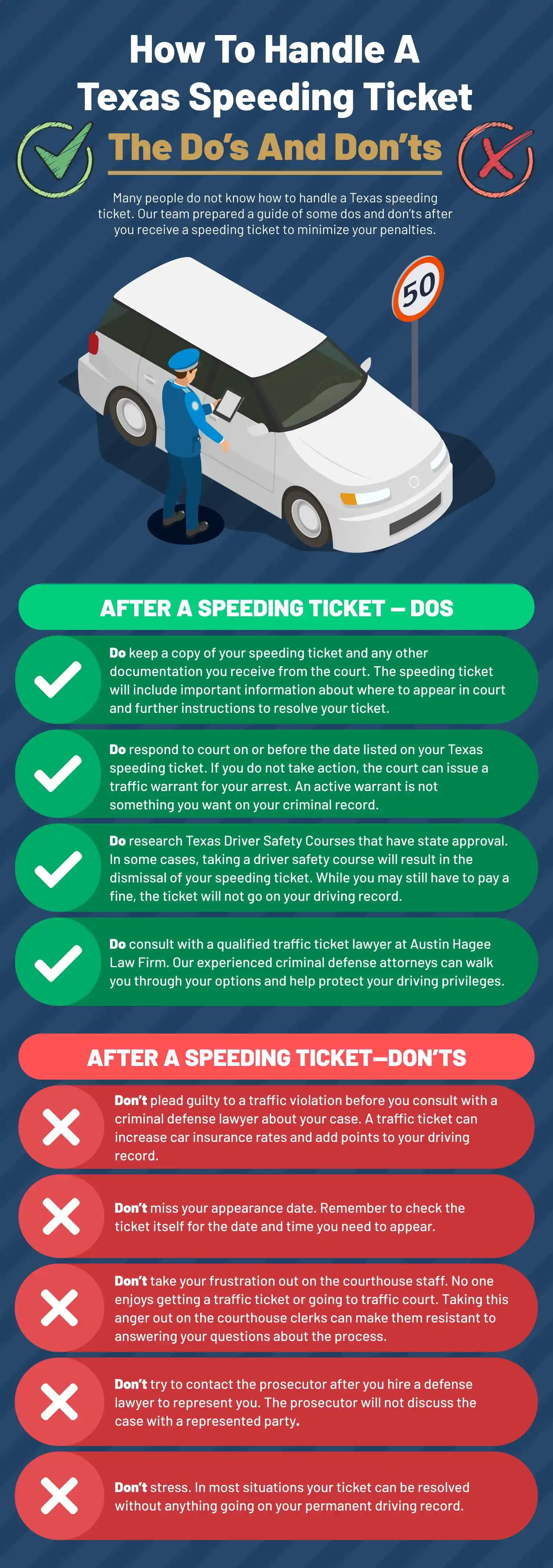
Get in Contact with a San Antonio Criminal Defense Lawyer Today
At the Austin Hagee Law Firm, we possess extensive experience representing clients in Texas traffic ticket cases, including speeding tickets.
We understand the potential consequences of a speeding ticket and will tirelessly work to protect your driving privileges. To speak with one of our defense lawyers, please contact us online or call (210) 500-3700.
Speeding Ticket in Texas: Frequently Asked Questions
What should I do immediately after getting a speeding ticket in Texas?
Review the citation carefully for deadlines and court instructions. From there, decide whether to pay the ticket, request a driving safety option if available, or contest the ticket in Texas traffic court. Acting quickly helps protect your driving record.
Can I fight my speeding ticket in Texas?
Yes. Drivers may contest a ticket in Texas traffic court rather than paying it outright. A defense may involve reviewing the accuracy of the alleged speed, officer observations, or procedural issues.
What are my Texas traffic court options for a speeding ticket?
Most drivers choose to pay the ticket, pursue a driving safety course if eligible, or challenge the ticket in court. The best option depends on your driving history and how important it is to protect your record.
Does Texas allow a driving safety course for speeding tickets?
In many cases, a Texas driving safety course may help prevent a speeding ticket from negatively affecting your driving record. Eligibility and deadlines vary by court.
Will a Texas speeding ticket increase my insurance?
A conviction can raise insurance rates, especially if you have prior violations. Protecting your record can help reduce long-term insurance costs.
How much are Texas speeding fines and penalties?
Fines vary by location and alleged speed, and often include court costs. The true cost may also include higher insurance premiums.
Can I keep a speeding ticket off my driving record in Texas?
Depending on eligibility, a driving safety course or a successful court outcome may help keep the ticket from appearing on your record.
What happens if I ignore a speeding ticket in Texas?
Ignoring a ticket can result in added penalties and complications. It is important to respond before the deadline listed on the citation.
Do points matter on my Texas driving record?
Points and violations on your driving record can affect insurance rates and future driving privileges, even if the fine seems minor.
Should I hire a Texas traffic ticket lawyer?
If protecting your driving record is important, speaking with a Texas traffic ticket lawyer can help you understand your options and pursue the best possible outcome.

What should you know if your criminal case is indicted in the state of Texas?
An indictment formally charges a person with a crime. During the proceeding, a grand jury determines if sufficient evidence exists to bring criminal charges.
To secure an indictment, the prosecuting attorney must convince at least nine of the twelve grand jurors of his or her argument. The argument being that there is sufficient probable cause to believe the defendant is guilty of the felony in question.
In the Texas criminal system, generally only felonies are indicted. An indictment is the first step that allows the prosecution to formally accuse you of a felony crime.
Key Takeaways
- An indictment is a formal criminal charge issued by a grand jury after reviewing evidence in felony cases.
- Texas requires grand jury indictments for felonies, except in certain plea bargain situations or waived rights.
- You may not be arrested immediately after indictment—law enforcement will serve a warrant or arrange a surrender.
- A skilled defense attorney can intervene early by presenting evidence or negotiating before the indictment is finalized.
Grand Jury Review: The grand jury examines the evidence to determine if there is probable cause to believe a crime has occurred.
Deliberation: After reviewing the evidence, the grand jury discusses whether the suspect likely committed the crime.
Indictment Decision: If sufficient evidence is found, the grand jury issues an indictment, which formally charges the suspect with the crime. The term indictment means that your felony criminal case is now moving towards trial. In other words, it has been formally filed in a felony court.
The Indictment Process
This accusation itself comes from a group of regular citizens called a grand jury. When you are arrested for a potential felony, it is the prosecutor’s job to gather evidence proving the crime. They then present the evidence to a grand jury.
The grand jury, in Texas, is a group of regular citizens who carefully analyze the evidence presented by the prosecution.
If 9 out of 12 of the grand jury members agree that there is sufficient evidence, an indictment is issued for Texas felony cases.
Why Have the Indictment Process?
Since a felony is such a serious offense, the indictment process is an extra legal safeguard in place to prevent cases with insufficient evidence from being filed.
So, each case and its supporting evidence is formally reviewed by a prosecutor, who presents it to a grand jury to show them all the objective facts of the case.
If the prosecutor does not share all the objective facts, they can be criminally charged for prosecutorial misconduct.
For these reasons, the indictment process is extremely important. Every case must be carefully executed to limit potential mistakes throughout the indictment process.
Below, the San Antonio criminal defense attorneys at Austin Hagee Law Firm go over what you should know about criminal case indictment.
If you have questions, please contact us online or call (210) 500-3700.
What Steps Should I Take If I Am Indicted in Texas?
An indictment is a defining moment in a criminal case. This is because it indicates whether a portion of the public (grand jury) believes that the prosecution’s evidence is enough to present a case against you.
If a grand jury indicts you with a criminal charge, then you need to have a skilled criminal defense attorney to represent you and fight the allegations.
If you find yourself facing an indictment for any criminal charge, relying on an experienced attorney is the best way to defend yourself against the prosecution. Why?
Because only seasoned criminal defense attorneys have first-hand experience navigating the criminal justice system.
Skilled trial attorneys possess specific abilities to win a case. In other words, they can analyze the evidence and form the best defense strategy for every set of facts in a specific case.
Does Indictment Mean Jail Time?
An indictment requires the accused to stand trial for a crime but does not guarantee jail time.
Why Should I Hire a Criminal Defense Attorney for a Criminal Case?
Common legal jargon used in the criminal justice system can be difficult to understand. Which is why criminal charges should never be faced without an attorney or an ill-prepared one.
That is because niche legal terms can often leave you confused and make it difficult to understand how your case is progressing. This is why you want someone that can properly explain the process to you.
Criminal cases are sufficiently overwhelming on their own. So, you should never be left confused or without fully understanding the legal impacts of your case.
Get in Contact with an Experienced San Antonio Criminal Defense Lawyer Today
The legal team at the Austin Hagee Law Firm specializes in helping clients navigate smoothly through the criminal justice system.
Austin Hagee is a criminal defense firm that takes pride in guiding clients through every step of the legal process.
If you or a loved one find yourselves facing a criminal charge or a possible indictment in San Antonio or the South Texas area, contact Austin Hagee Law Firm for a free case evaluation.
They have the knowledge, experience, and expertise to help you build your best defense.
What Is an Affidavit of Non-Prosecution?

An affidavit of non-prosecution is a sworn, notarized statement from a victim requesting that charges against a defendant be dismissed.
An affidavit of non-prosecution is a legal statement where the victim or witness of a crime formally declares they don’t want to press charges against the accused. This document can influence the decision to proceed with the case, though it doesn’t guarantee the charges will be dropped.
This affidavit serves as an important legal declaration and is subject to penalties, including perjury charges, if it contains false or misleading information.
Non-prosecution affidavits are commonly used in various legal contexts, such as criminal cases or domestic violence situations, to clarify the plaintiff’s stance on pursuing charges or legal actions.
If you are facing an assault or criminal charge in Texas, the cooperation of the victim or witness can be crucial for the prosecution’s case.
There are many instances in which a domestic dispute escalates to a criminal charge even though the alleged victim does not want to prosecute.
These situations can be very distressing for couples and require an experienced criminal defense lawyer to assist them in navigating the criminal justice system and keeping their criminal record clean.
In such situations, an affidavit of non-prosecution may be an instrumental legal document to assist your attorney with weakening the prosecution’s case against you and increase the likelihood that your case may be dismissed.
In these instances, dealing directly with the witness can be a delicate matter, and to avoid charges of witness tampering (a felony offense) you should leave this process to an experienced criminal defense lawyer who can carefully guide you through each step.
To get started with a criminal defense lawyer today, please contact us.
What Is a Non-Cooperative Witness in a Criminal Case?
A non-cooperative witness is an individual who is unwilling to provide testimony in a criminal case for the prosecution. Their lack of cooperation can include evasive answers or a refusal to testify against the defendant.
In cases where a witness is crucial to the prosecution’s case, their unwillingness to cooperate can leave them with a very weak case.
How to File an Affidavit of Non-Prosecution in Texas?
To file an affidavit of non-prosecution in Texas, follow these steps:
- Contact the District Attorney’s Office in the county where the case is being prosecuted.
- Request the necessary forms for filing an affidavit of non-prosecution.
- Fill out the forms accurately and completely.
- Submit the completed forms to the District Attorney’s Office or consult a private attorney who can assist you with the filing process.
Why Do I Need a Criminal Defense Lawyer to Draft and File an Affidavit of Non-Prosecution for Me?
When drafting an affidavit of non-prosecution, you have to obtain the signature of the victim for it to have any value or credibility.
However, you must be wary of not putting any words in the witness’s mouth or influencing their statement in any way.
Every single word in the document has to be exactly what the witness wants to say, otherwise, it may be seen as witness tampering.
Witness tampering is a felony offense and creates a legal minefield for someone that is not skilled in explaining the situation to a potential witness.
To add to the complexity, in many cases, the defendant trying to contact the alleged victim has a bond condition of no contact with the witness, meaning they are not allowed to have any contact with the alleged victim.
In these cases, reaching out to the alleged victim would be a violation of their bond conditions, and they may get a bond violation or a new felony charge of witness tampering if the situation is not handled properly.
For all of these reasons, it is essential to employ a criminal defense attorney to help you with this process successfully.
How Does Notarizing an Affidavit of Non-Prosecution Add Legal Credibility?
The process of notarization involves a certified notary public witnessing the signing of a legal document and in order to verify the identities of all parties involved.
Notarizing the document adds an additional layer of credibility and authenticity to the affidavit, so there can be no disputing that it is real, valid and can be held up in court.
An affidavit of non-prosecution is more effective when notarized because notarization proves that the person who signed it is who they say they are.
In most situations, the court will not even accept an affidavit that is not notarized. Affidavits that are not notarized are seen as inauthentic and will have trouble overcoming hearsay objections.
What Is the Impact of an Affidavit of Non-Prosecution on the Prosecutor’s Case
An affidavit of non-prosecution has a huge impact on the prosecution’s case because it unveils whether the victim would like to cooperate in the case.
Many prosecutors are juggling a large docket of cases and until they are ready to go to trial, they don’t have the ability to communicate often with the victim.
Filing an affidavit of non-prosecution tells them in advance that this victim most likely is not going to be on their side and that they are going to have to prove this case without them.
As a prosecutor, this can make their case very challenging, since jurors do not like hearing a case where the victim doesn’t even care enough to show up to the trial.
Contact the Austin Hagee Law Firm to Start Helping with Your Criminal Case
At the Austin Hagee Law Firm, we have attorneys with years of experience as prosecutors and many different types of criminal matters.
We have been on the receiving end of an affidavit of non-prosecution, and we know what it can do to the state’s case.
We will work with you and your situation to produce the best possible result and help you secure an affidavit of non-prosecution if possible.
Retaining our firm is a smart first move if you want someone who is experienced with navigating this important process in your criminal defense case.
If you have a question about how an affidavit of non-prosecution could be relevant to your case, the Austin Hagee Law Firm offers free case evaluations.
Our legal team is ready to listen to your concerns, analyze your situation, and start building your best defense. Contact us today to get started.

In Texas, individuals do not have a duty to retreat. This means individuals are allowed to use force against others who are using or attempting to use unlawful force against them or someone else.
This is known as the Texas stand your ground law. Under this law, self-defense is a complete defense to a criminal charge, as long as certain circumstances are met.
In this detailed guide, we’ll go over several aspects of this topic, including:
- What the Stand Your Ground Law is and when it applies,
- 3 Conditions for when the Castle Doctrine applies, and
- When a self-defense claim is not permitted.
If you want to know whether the stand your ground law applies to your case, contact our team at Austin Hagee Law Firm.
Our San Antonio criminal defense lawyers can walk you through the criminal process and help ease the burden on you every step of the way.
What Is the Stand Your Ground Law, and When Does It Apply?
Texas is indeed a stand your ground state under the Castle Doctrine, allowing individuals to defend themselves when they perceive a threat to their life or safety. This law absolves individuals from the duty to retreat before using force in self-defense. However, it’s crucial to understand that stand your ground laws have specific legal nuances, and the interpretation of what constitutes self-defense versus excessive force can vary. Therefore, while Texas enforces stand your ground laws, individuals must exercise caution and ensure their actions align with legal standards.
Furthermore, you can legally employ deadly force when it’s deemed absolutely necessary to prevent specific violent crimes like sexual assault, kidnapping, murder, or robbery.
In order to qualify to claim self-defense, the accused must:
- Reasonably believe force was necessary to stop or prevent the target’s use of unlawful force,
- Not provoke the unlawful force,
- Not be engaging in a crime, and
- Use the minimum force reasonably necessary to defend oneself or another in the situation.
What Is the Castle Doctrine in Texas?
When someone is at home, at work, or in their vehicle, they can use proportional reasonable force to defend themselves. So long as they have a reason to believe the target is attempting to break and enter, about to commit an imminent assault, or is trying to remove them from their location.
In situations similar to this, under Texas law, lethal force is appropriate by the defending party. This is known as the castle doctrine.
Self-defense can arise for criminal charges such as:
- Assault,
- Aggravated assault,
- Murder,
- Manslaughter, or
- Kidnapping.
Contact our office today to discuss your case and determine whether self-defense is a viable defense for you.

When Is a Self-Defense Claim Not Permitted?
In certain circumstances, self-defense is not a valid justification for using force. The defendant cannot claim self-defense if they:
- Used force against a police officer during a lawful arrest,
- Provoked the use of force, or
- Responded with force during a verbal confrontation.
Additionally, the use of force must be proportional to the force being threatened by the other party. Deadly force may be justified when someone is attacked inside their home, work, or vehicle.
Contact a Criminal Defense Attorney at Austin Hagee Law Firm to Discuss Texas Stand Your Ground Law
If you are facing criminal charges for defending yourself, a criminal defense lawyer can offer valuable information and resources to help get your charges reduced or dismissed.
An experienced criminal lawyer can assist you by:
- Interviewing witnesses to testify on your behalf;
- Locating any police reports describing the incident;
- Obtaining surveillance footage that captures the incident;
- Determining whether self-defense applies to your case;
- Negotiating with the district attorney to reduce or drop your charges; and
- Preparing your case for trial, if necessary.
The defense attorneys at Austin Hagee Law Firm are here to advocate for you and stand by your side throughout the criminal process.
A valid self-defense claim can completely justify your actions against the perpetrator. As former prosecutors, we know what facts to look for to solidify your self-defense claim.
Contact our office today to discuss your case with a qualified criminal defense lawyer.